
79 Years of Independence; Are We Really Free?
Seventy-nine years after independence, the question is no longer whether India is free, but what freedom truly means for those who live in it
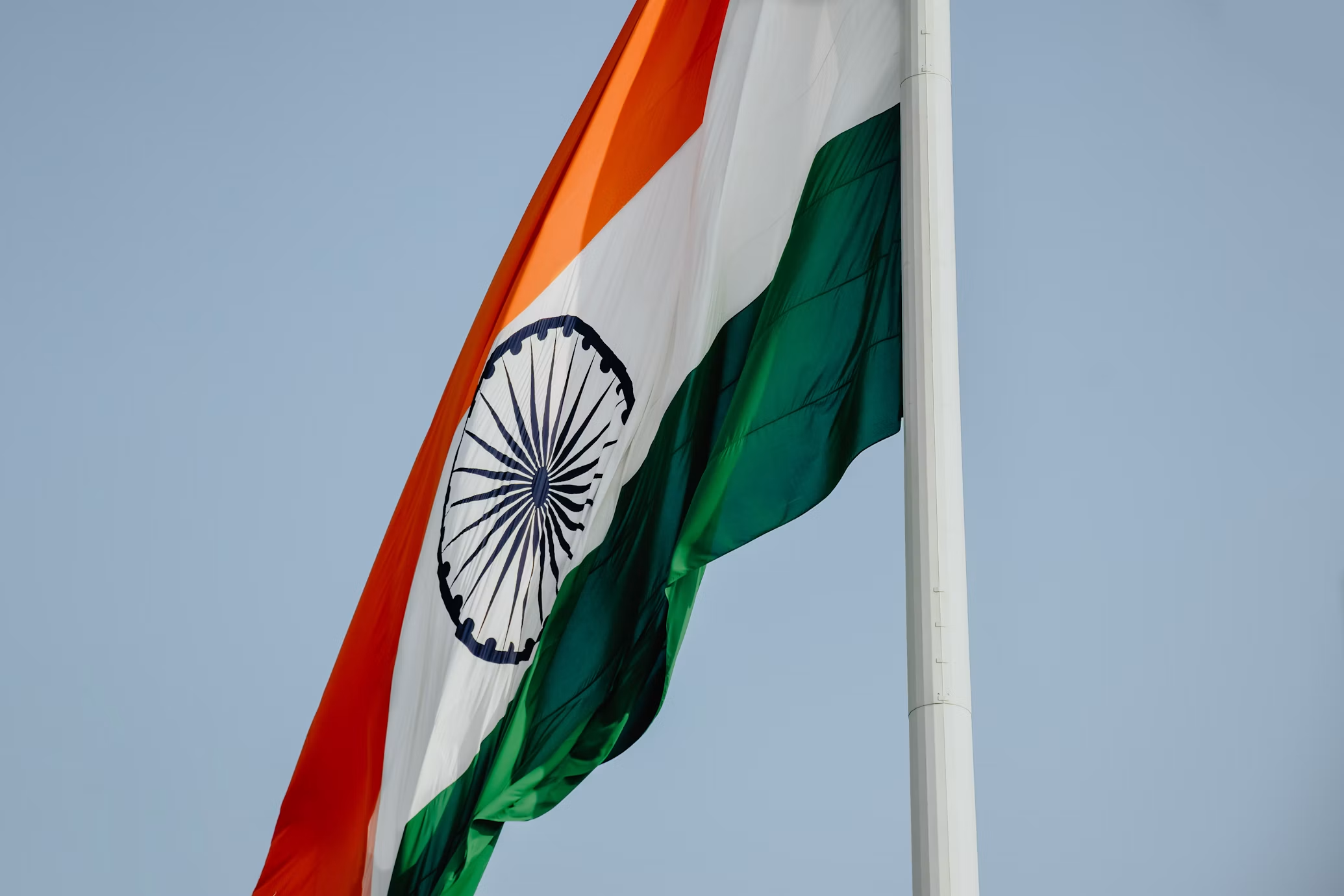
Every year on 15 August, India celebrates its independence with great pride. The tricolour flies high above government buildings, schools organise cultural programmes, speeches are delivered, and millions pause to remember the sacrifices of those who fought for freedom. It is a day that marks the end of colonial rule and the beginning of India's journey as a sovereign nation.
Yet, amidst the celebrations, a question continues to echo across generations. Are we really free?
At first glance, the answer appears obvious. India is a republic of its own. It is the people who elect their government, has constitutional rights and is ruled by laws of their own people, not foreign ones. The answer would appear to be a resounding yes as compared to 1947 India.
A nation may be independent while its people continue to struggle with barriers that limit their ability to think, speak, choose, and live with dignity. The question, therefore, is not whether India is free from colonial rule. The question is whether freedom, in its fullest sense, has reached every citizen.
There are more than a few definitions of the word free. A nation can be independent, but its people still face obstacles in their thoughts, speech, choice and life that hinder them from thinking, speaking, choosing and living with dignity but the question is not whether India is free from colonial rule. So the question is, has freedom been extended to all citizens in its fullest?
The generation that fought for independence sought political freedom. They wanted the right to govern themselves, to determine their own future, and to reclaim their national identity. In that mission, they succeeded. The British flag no longer flies over India. The laws of the land are made in New Delhi, not London. Governments rise and fall through elections, and power ultimately derives from the will of the people.
But those who founded the Republic knew that independence wasn't enough. This is why the Constitution went beyond the establishment of institutions of governance. It guaranteed justice, liberty, equality, and fraternity. It acknowledged that the transfer of political power was not the only factor of freedom. It has to affect people's daily lives in ordinary lives.
This difference is still applicable to this day
One may have constitutional rights in theory but not in practice because of a lack of freedom to express an unpopular opinion. Political freedom for a child who is denied quality education due to factors beyond his control can be a freedom without opportunities to exercise it meaningfully.
A woman who cannot walk safely at night, a worker who is stuck in cycles of poverty, or a person judged for what he is, rather than what he can do, may ask the same question from a different point of view: are we free?
In some ways, freedom is associated with not having chains on you, but in reality, there are chains in modern societies which are not visible. Some are economic, social, cultural or psychological.
An individual can have the right to vote but lack the ability to impact public life. A student can have freedom to learn but must be weighed down by systems that encourage conforming to learning rather than learning out of curiosity.
A citizen can be free to express himself or herself, yet be on the verge of being reluctant to do so due to the possibility of social isolation, public backlash, or professional repercussions.
But no legal guarantees can be the sole measure of freedom. It additionally needs to be seen in terms of how much individuals feel empowered to make use of these guarantees.
This is no tough problem for India alone. History has shown that freedom is achieved, but it is not a static condition. It's an ongoing process. Each generation is granted certain freedoms, and asked to advance them even further.
Colonial rule did not bring a struggle for freedom to a close. It just changed its shape.
At one time, freedom was synonymous with independence from foreign rulers. For another, it meant justice and equality in society. For the generation of today, it might mean upholding the values of the Constitution, the principle of equal opportunity, the dignity of the individual and the concept of liberty in a fast-paced digital age.
Technology has added a new dimension to the debate. Today, we have unprecedented access to information but many of us are being influenced more and more by algorithms, misinformation and digital echo chambers. We are more connected than ever but not necessarily more independent in our thinking.
Now the discussion of freedom is moving beyond governments and institutions into the arena of ideas, information and influence.
That's why the question of ‘Are we free?’ will not go away. It's not a criticism on India, nor a rejection of the immensity of progress that has taken place in India. Instead, it is a reminder that “freedom is not to be won, hung on the wall, and kept for eternity.” What's the responsibility that must be safeguarded, extended and newly conceived with every successive generation?
The answer is not just "yes" or "no.
India is free. Well there's no serious doubt about it, but freedom is not a yes or no thing. It can have various intensities and various impacts. The promises of liberty are enjoyed by some citizens, but not others. Some barriers have been toppled, others are standing strong.
The question for India is not, is it free, but is it going to make freedom real, more meaningful, and more accessible for every individual?
As the nation continues to make its march, perhaps the central question is not, “Are we free?” Perhaps it is:
What freedom that we owe each other remain?
That question is more important than any anniversary we can celebrate for a nation that wants to be independent, but it also wants to be just, equal and democratic.
Latest News
- ◆Starship Reaches Orbit for the First Time and Deploys 26 Starlink Satellites
- ◆Supreme Court Refuses to Stay UPI Merchant Charge, Notice Issued to Centre
- ◆Gandak Reaches Record 91.25 Metres, Breaching Embankments in Bihar and Uttar Pradesh
- ◆Kunal Kamra Moves SC Over Legislative Privileges, Free Speech
- ◆Rahul Gandhi Urges Gen Z to Protest for Women's Safety