
India's Diplomacy in a Fractured World Order
From G20 leadership to BRICS presidency, India is positioning itself as a balancing power navigating a shift from large forums toward smaller, agile coalitions
Synopsis
India's foreign policy in 2026 is formally multi-aligned, joined to the G20, BRICS, Quad and smaller issue-based groups, having embraced a nonaligned approach 12 years after Independence. In this article, we'll explore the history of India's recent diplomatic efforts, the successes it's achieved, and the challenges it's faced in balancing its relationship with the United States, China, and its neighbourhood.
The dynamics of Non-Alignment to Multi-Alignment
The foreign policy paradigm has been undergoing a transformation of meaning and action over the decades, while keeping its basic goal intact. This continuity, analysed recently, is clearly an unalterable part of India's foreign policy — Jawaharlal Nehru wrote about it as Non-Alignment; Today it is known as Strategic Autonomy.
The report described the existing policy as a "Multi-Aligned Foreign Policy Grounded in Strategic Autonomy", which was to become a contrast to the Soviet bloc and the West during the Cold War.
The G20 Presidency and Its Afterlife
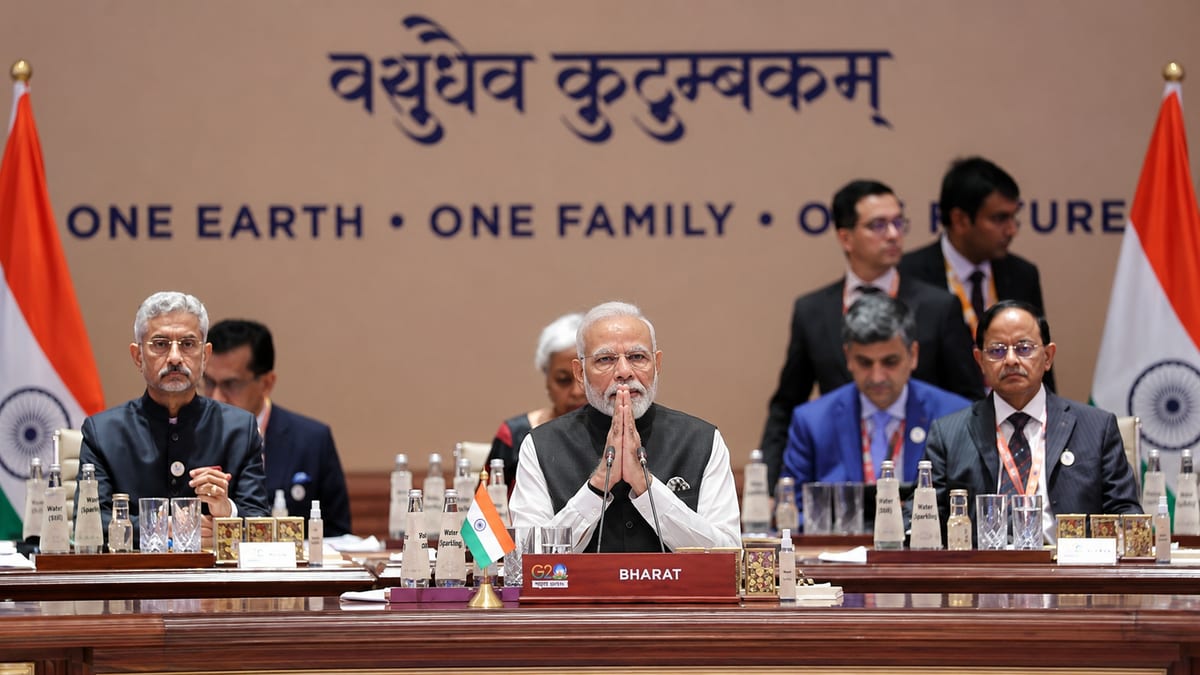
The most conspicuous feature of India's recent diplomatic drive is the year it spent as the G20 president (most of 2023), which has left its imprint on policy in 2026. India's own account during his tenure as President of the G20 highlighted its greater achievements in delivering 87 outcomes and 118 adopted documents, compared to the previous years, to "reinvigorate" multilateralism and to "strengthen the global voice of the Global South.
The presidency's theme, "Vasukudham Kudumbakam" ("one earth, one family, one future"), came from the ancient Upanishads and was explicitly linked with the UN Sustainable Development Goals, the authors of the analysis in The Defence Horizon Journal found.
India's successful bid to get the African Union permanently promoted to the G20, which has been interpreted by analysts as a modernized form of Afro-Asian solidarity from the Bandung era, has been reframed in today's jargon — as a debt relief, food security and digital infrastructure initiative — instead of a call for a revolt against colonialism.
The shift of the BRICS, Quad and “Small Tables”
India has maintained its multi-layered interests in several constellations till 2026. India is the current president of the grouping of the BRICS countries, as well as a member of the Quad grouping with the United States, Japan, and Australia and will be the president of the grouping in 2026.
This analysis also noted a larger trend that is changing the way India — and diplomacy in general — is doing business now: Big and cumbersome bodies such as the UN and the G20 are increasingly ineffective at delivering tangible outcomes in light of domestic politics and geopolitical rivalry, while smaller, more focused, more agile groups, dubbed "small tables", are bringing "big dividends".
This change has implications that have practical consequences. India does not seem to be interested in reaching a consensus among dozens of member states with competing interests but instead focussed on smaller groupings (like trade blocs, dialogues on security, technology partnerships) for faster consensus, negotiations and delivery of outcomes.
The strongest lever of economic diplomacy is the economy itself
Economic diplomacy is always seen as the most useful tool of India's foreign policy, irrespective of any formal alliance or bloc. The initiatives like the export of digital public infrastructure, Unified Payments Interface, leadership in the International Solar Alliance, vaccine diplomacy have certainly boosted India's global image and influence as per an article in the Sunday Guardian in June, 2026.
In fact, in this particular instance, the Indian pharmaceutical and technology industries, covered on their own in the articles on the export of vaccines and the UPI use in other countries, directly shape the nation's foreign policy, fusing the concepts of commercial success and soft power.
Progress has also been made in trade negotiations. The signing of trade pacts between the UK and India and Oman in 2025 were also flagged by PM-FIAS for the government to emulate with the EU, the USA, GCC and ASEAN in the short term.
The continuing conflicts
India's diplomatic year is inevitably bound up in its limitations. The Hudson Institute and others have cited poor relations on a number of fronts at the same time. As part of the Quad, New Delhi's concerns have been limited by engagements with Washington, including through the iCET and defence cooperation, and singling out Trump's dual-track foreign policy has raised doubts among allies, Diplomatist magazine pointed out.
Locally, the situation is far from clear-cut. Political changes in Bangladesh and Nepal, along with ongoing issues with their neighbour Pakistan, indicate that South Asia's stability is not a given even as India pursues its ‘Neighbourhood First’ policy, the Sunday Guardian's analysis read.
As India keeps on preparing for its next visits to the SCO summits along with China, meanwhile, PM-FIAS analysis posited that there will be continuing India–China frictions, a fact that exemplifies the multi-alignment tightrope India must tread: being with rivals in multilateral forums, while remaining on friendly terms with them bilaterally.
An information provider of the Indian Ocean
There is a lesser degree of ambiguity with respect to the Indian Ocean Region and India's diplomatic and security role. Policy tracking refers to the fact that India is a "net security provider" in the region, supported by anti-piracy patrols and humanitarian assistance and disaster relief operations like Operation Sankalp.
The position is less one to provoke any international furor than India's stance on great-power rivalry, partly because it would be in favour of most regional and extra-regional actors, including western navies that operate in the same waters.
India's 2026 foreign policy is more about finding a way to translate 'scale' — the world's most populous country and fifth largest economy — into structured influence on multiple, overlapping platforms, than it is about any one alliance obligation.
There are real gains stemming from the institutional legacies left by the G20 presidency, in the form of continued leadership by BRICS and the continued progress of economic diplomacy, thanks to digital infrastructure and vaccine exports. However, trade and visa issues with Washington, border disputes in the near vicinity with Beijing, and the problems in the neighbourhood remain as genuine limitations.
Whether India's multi-alignment diplomacy will be interpreted as "balancing" or will become more of a reaction to shocks that come from elsewhere will likely be the main issue in the Indian diplomacy of the next decade.