
BJP Storms West Bengal, Crosses 200-Seat Mark
With record-breaking voter turnout and gains in Kolkata's TMC strongholds, BJP's mandate reshapes Bengal's political landscape
Synopsis
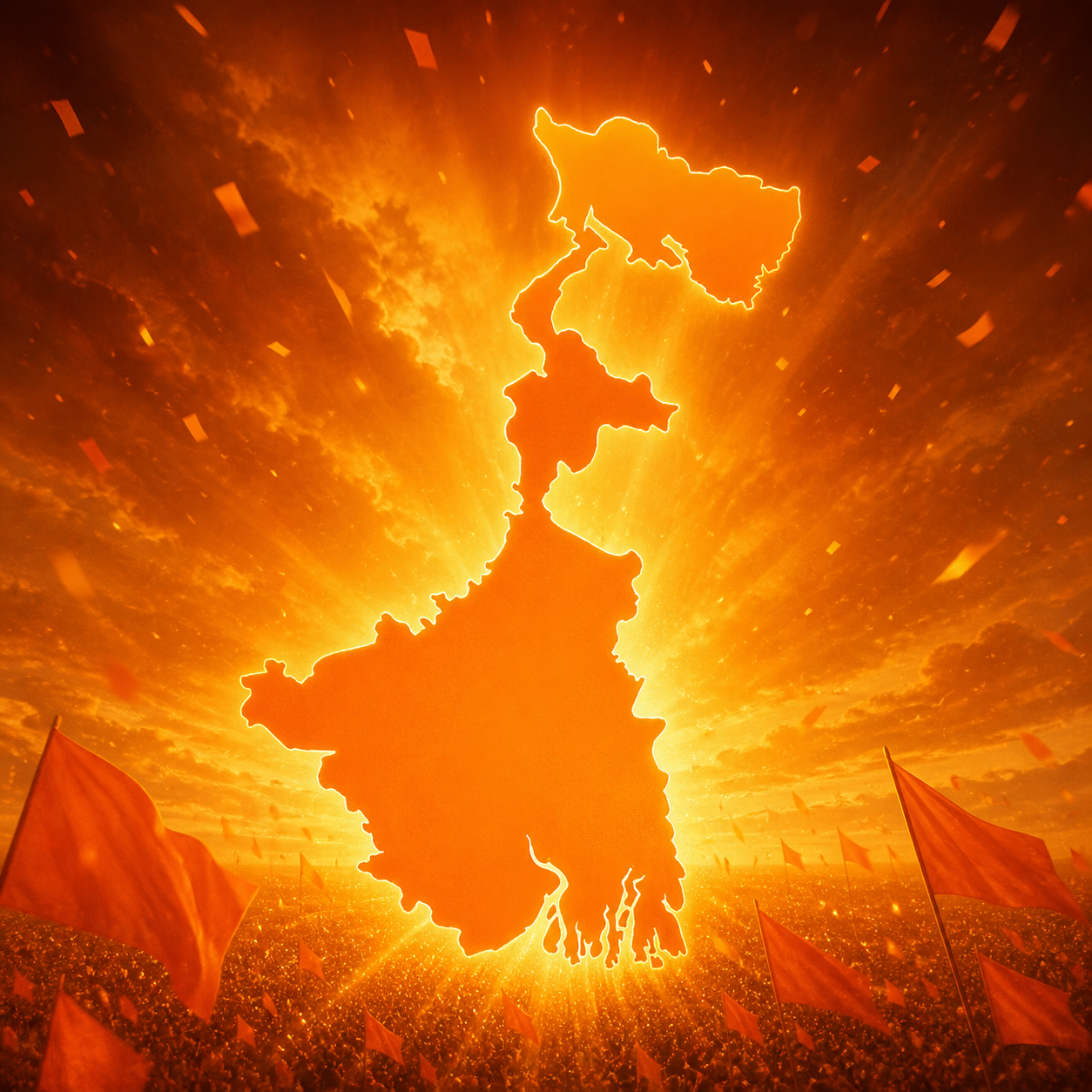
West Bengal's 2026 Assembly election count points to a sweeping BJP surge, with the party leading or winning in 206 of 293 seats counted. Record turnouts of over 91% in both phases and BJP penetration into Kolkata signal a profound realignment in one of India's most politically competitive states.
West Bengal 2026: BJP Crosses 200 as Bengal Crosses its Red Lines and Fades to Saffron.
As the counting of votes continues, the Bharatiya Janata Party is consolidating north Bengal, punching into Kolkata - and the figures are bothering the leadership of Trinamool. The Veritas Bureau May 4, 2026
Telly Telling a Story
When data released by the Election Commission of India showed BJP 113 wins and 93 leads in West Bengal by Monday evening a combined total of 206 seats in 293 counts has become hard to deny.
The party was led by 81 seats: 46 won, 35 leading. The All India Trinamool Congress, in power in the state since 2011 under the leadership of Chief Minister Mamata Banerjee, secured the 81 seats. The Indian national congress took care of 2 victories.
In response to the emerging trends, Prime Minister Narendra Modi congratulated the people of the State, on this spectacular mandate of the people- a phrase underscoring the BJP interpretation of the results as a verdict of the people.
The leadership of TMC was not so optimistic. The trends that were emerging were described by senior party figures as fishy and they urged restraint in drawing conclusions based on early leads and they warned against jumping the gun and shouting a landslide.
Where the Votes Moved - and Why It Matters
The BJP had now entered the 2026 election having already consolidated a lot of ground in north Bengal and some parts of southwest Bengal - constituencies that it had been taking seriously in the last few cycles. What is notable about this tally, however, is the reported incursion into constituencies in and around Kolkata which have long been the electoral base of TMC.
Based on the ECI data, the BJP won the seats of Kalimpong, Darjeeling, Monteswar, Bhatar, Medinipur and Asansol Dakshin which represent the geographic breadth of the state.
The TMC, in its turn, retained the Bhagawangola seat in Murshidabad district where its candidate Reyat Hossain Sarkar won the nearest rival by a margin of 56,407 votes - which makes it clear that there are still pockets of TMC strength even though the overall picture is changing.
Turnout: Civic Participation Record
Among the reasons why this cycle stands out among earlier Bengal contests are the magnitude of voter turnout.
The first phase, which was conducted on April 23, had a turnout of 92.8 per cent. The second stage on April 29, saw 91.47 per cent polling. The figures are both the highest turnout the state has ever seen since Independence.
Very high turnout elections in India do not necessarily favour either party, but long-time political observers have long noted that when the tally is being counted, high turnout elections often serve only to remarkably increase voter turnout, and not necessarily to increase voter turnout on a consistent basis.
What the Mandate Portends outside Bengal
A BJP administration in West Bengal - had the leads had their way - would have repercussions far beyond the borders of the state.
In politics, it would be the first time since 2011 that the TMC loses Nabanna, and this will end over a decade of Mamata Banerjee administration. To the BJP, it would mark the achievement of a long-standing strategic goal: electoral supremacy in a state that had traditionally been an obstacle to the progress of the party.
West Bengal, as the home to approximately 100 million people, with Kolkata as a major commercial and cultural hub, would enter a new administrative phase at a critical juncture, as the state enters post-COVID recovery, gaps in infrastructure investment, and labour market strains.
In the case of national politics, the outcome will be a substantial piece of data before the 2029 general election cycle.
Counting Continues
As of 8:00 PM on May 4, 2026, ECI data showed 293 of 294 seats counted. The last seat was still pending. Authoritative statements on separate constituencies are likely to shortly appear in the hours that follow.
In a democracy, election results seldom tell a single story - but the numbers that emerge out of West Bengal on May 4, 2026, is an indicator of one state in the midst of a structural political transition, the full arc of which will take years, not hours, to fully appreciate.
Latest News
- ◆Delhi Approves DURGA Scheme for 1,300 Pink E-Autos for Women, Transgender Drivers
- ◆Black Sea Disruptions Push Bangladesh Back to Indian Wheat After Four-Year Gap
- ◆Microsoft's Hyderabad Cloud Region Opens as Telangana Targets 5 GW of Datacentres
- ◆Gold Slips in India as Firm Dollar and Fed Rate-Hike Bets Weigh
- ◆Rupee Slips to One-Week Low as Oil Rally Revives Global Rate-Hike Fears