
Centre Proposes Redistribution of Lok-Sabha Seats based on 2011 Census data
The suggestion by Centre to determine LS seats based on 2011 Census data is a cause of federal tension, with southern States most likely to lose seats to Hindi heartland
Synopsis
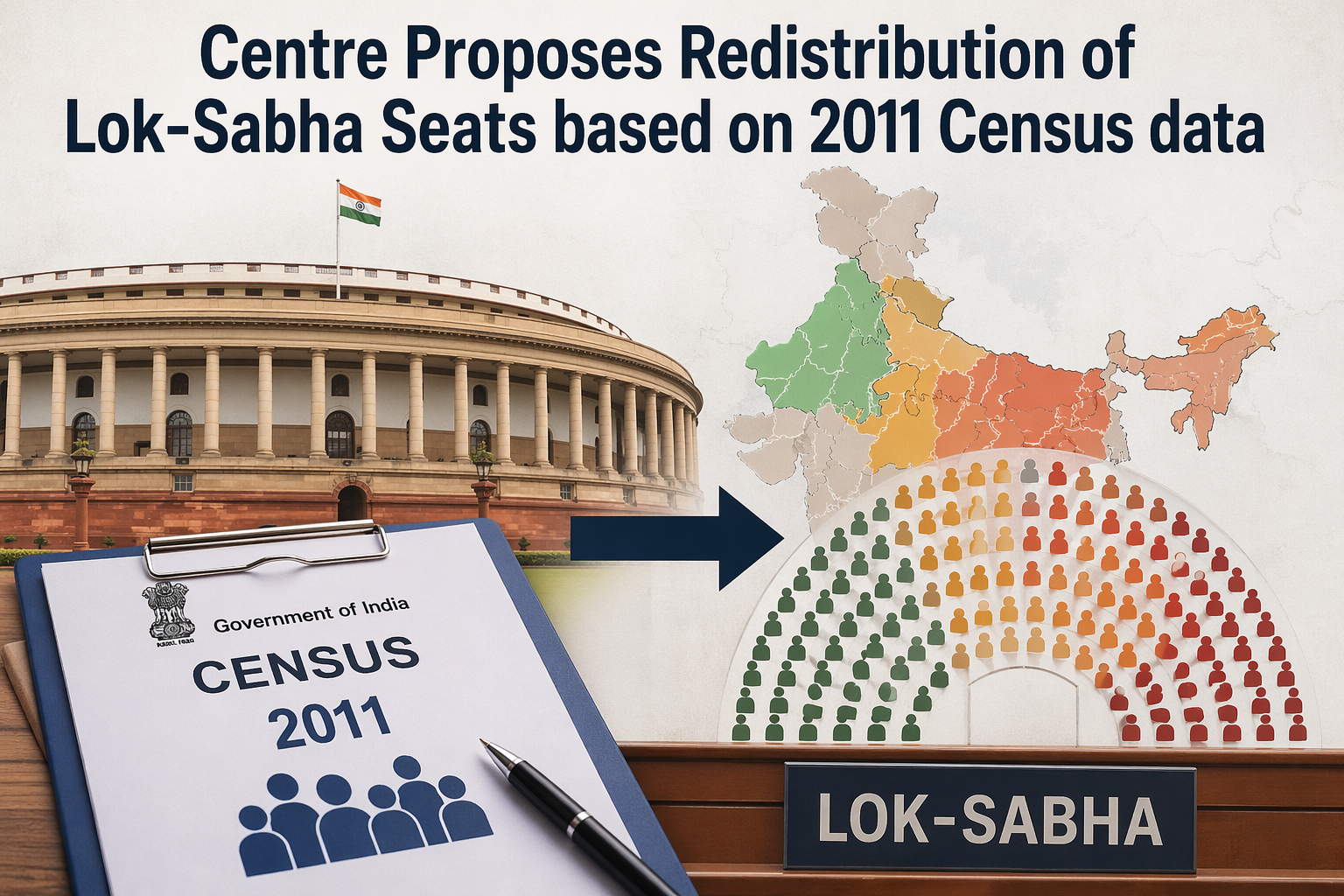
The decision of the Union government to begin an inter-State redistribution of Lok Sabha seats on the basis of 2011 Census has brought back a long-old debate on representation and federal equilibrium. Constitutional Amendment Bill and Delimitation Bill draft proposals propose a structural change that is likely to have a profound impact on the political geography of India before the next round of general elections.
The Background: Why Delimitation Now?
The present distribution of Lok Sabha seats in India is based on the census of 1971, and freezes have been made since then with the intent to promote population control. The Constitution (Article 82) requires periodic readjustment, but this has been postponed several times.
As the freeze will expire once the first Census after 2026, the plans of the Centre is the start of the politically sensitive transition. It is planned to increase the Lok Sabha strength to up to 850 seats, as compared to the existing 543.
Who Wins, Who Loses?
The Inequalities in Representation of the Region.
The results of the proposed exercise have shown that there has been a definite change of parliamentary representation. States to the North and central ones (especially in Hindi heartland) are expected to receive seats because of greater rates of population growth.
Conversely, the southern States like Tamil Nadu, Kerala and Karnataka which have been able to stabilise the growth of the population may lose their share. It is estimated that the South percentage can reduce to 20.7% compared to 24.3% and the Hindi belt percentage can increase to more than 43.1% compared to 38.1%.
A Success Paradox In Policy
This leads to a paradox: the States which successfully applied the family planning policies run the risk of losing political power, which makes the issues of equity and incentives in the Indian system of federalism rather questionable.
Federal Faultlines and Political Reactions
Federal Faultlines and Political Reactions
Southern States political leaders have expressed their opposition. The issues are as far as erosion of federal balance or apprehension of centralisation of power. Tamil Nadu Chief Minister M.K. Stalin threatened to hold mass protests and Karnataka Siddaramaiah called the action a dangerous shift.
West Bengal Chief Minister Mamata Banerjee has framed the proposal as a bid to politically divide States, whilst the leadership of Telangana has demanded wider agreement.
Centre’s Justification
The Centre believes that delimitation is constitutionally necessary and is a demographic fact. It also associates the exercise with greater reforms, such as women reservation, which implies a comprehensive redesigning of representation.
The Centre believes that delimitation is constitutionally necessary and is a demographic fact. It also associates the exercise with greater reforms, such as women reservation, which implies a comprehensive redesigning of representation.
Federalism Under Strain
The suggested redistribution is at the heart of the quasi-federal nature of India. The overrepresentation of seats in populous States would cause a shift in the balance of legislative power, which would influence the policy priorities and fiscal distribution.
Economic and Social aspects
The change may be seen as a political penalty by Southern States that contribute to GDP and tax revenues. This may aggravate the regional differences and make the Centre-State relations more complicated.
Conclusion: a Test of Cooperative Federalism
Delimitation will also challenge the strength of the federal compact in India as the country enters a new stage of democratic development. The challenge of balancing demographics and equity in the region is not easy. It is not so much the problem of drawing boundaries anew, but of maintaining the spirit of cooperative federalism which has formed the backbone of the Republic.
In redefining representation, India needs to take care that it does not redraw the fine borders of unity.
Latest News
- ◆NSE's $2.3 Billion IPO Draws Over $10 Billion In Bids
- ◆India-New Zealand Free Trade Pact To Take Effect October 20
- ◆Tata Group Governance Feud Deepens Over Chandrasekaran's Term
- ◆India Reaffirms Push For Constructive Ties With Bangladesh
- ◆Teen Gang-Raped Near Delhi Temple, One Suspect Held In Encounter