
End of an Era? Nitish Kumar Resigns
With 21 years and ten terms as CM to his name, Nitish Kumar steps down, Deputy CM Samrat Choudhary will take over the State
Synopsis
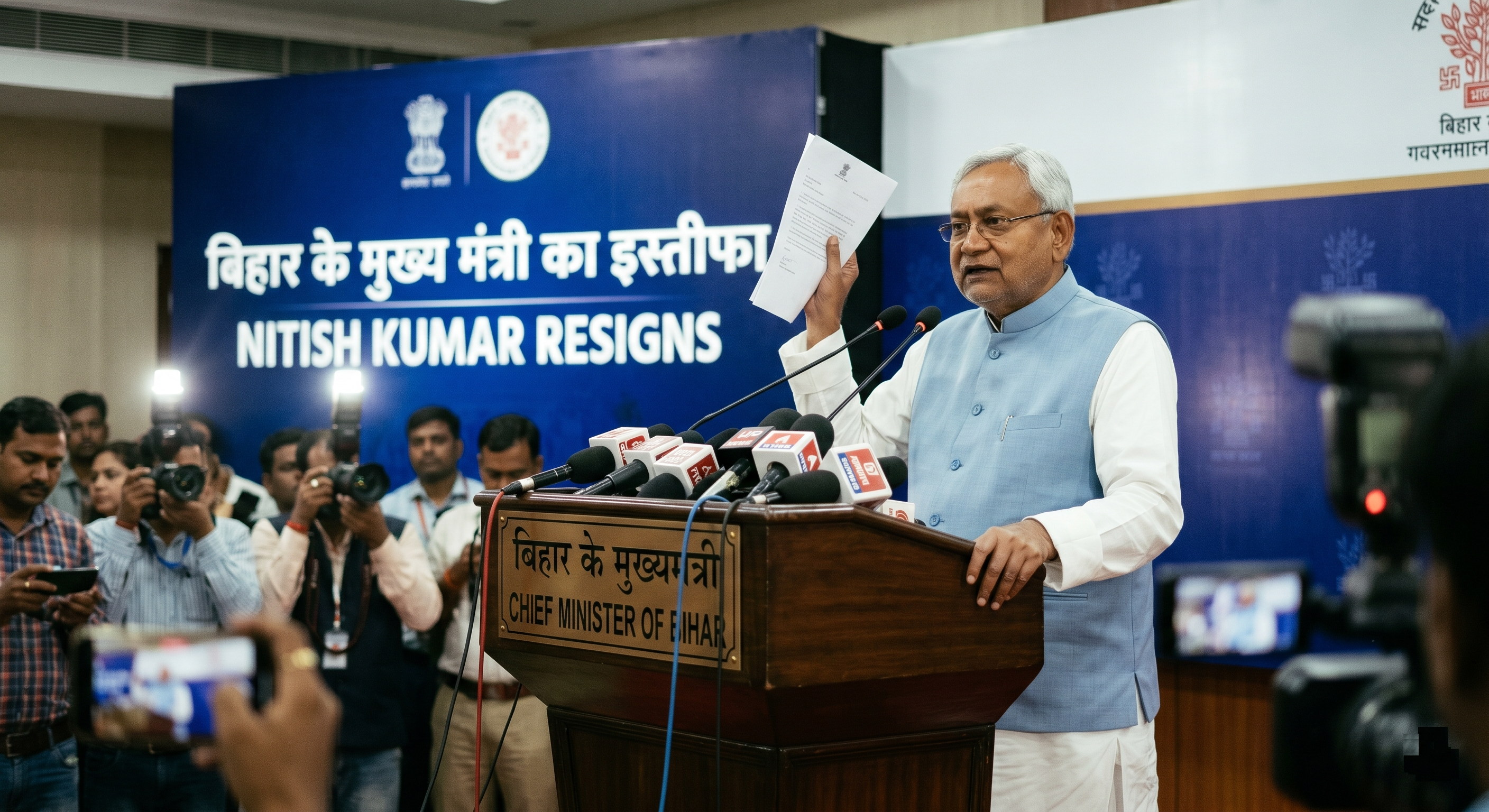
On April 14, 2026, Bihar Chief Minister Nitish Kumar resigned after 21 years in office. The newly elected BJP Legislature Party leader, deputy CM Samrat Choudhary, is poised to be the first BJP Chief Minister of the State, and has been scheduled to take the oath on April 15.
By the time Nitish Kumar entered his last Cabinet meeting on Tuesday morning, the political structure he had worked two decades to construct had been torn down. By afternoon there was a new political reality in Bihar: the Bharatiya Janata Party, the longtime coalition partner in the corridors of power in Patna, was now at the head of the table.
The Bihar politics were reshaped with the resignation that rewrote its political map
Mr. Kumar resigned on April 14, 2026, and his resignation was accepted by Lt. General (Retd.). Governor Syed Ata Hasnain. He held one last State Cabinet meeting before relinquishing power–a constitutional requirement that the Council of Ministers had to be dissolved before he formally resigned. The movement was typical of the man: procedurally meticulous, even on departure.
This was precipitated by the election of Mr. Kumar to the Rajya Sabha. By constitutional convention, a member of the Upper House is not to simultaneously serve a State executive office. His legislative transition, which saw him become Chief Minister with oaths as recent as November 20, 2025, marked an unusually shortfall end to an otherwise lengthy political history marked by a record ten years of tenure as Chief Minister.
Samrat Choudhary: Bihar first BJP Chief Minister
The succession and the sign it portends BJP Legislature Party leader was elected to the post after a meeting of the party MLAs in Patna with Deputy Chief Minister Samrat Choudhary installed as the successor, which made him a virtual certainty. His ascent is historic: it is the first time in the post-Independence history in Bihar when the BJP as such, not as an ally, nor as a coalition partner, will occupy the Chief Ministership.
This moment was prepared by the strong performance of the BJP in the 2025 State Assembly elections when it became the single largest party with 89 seats. What previously relied on JD(U) of Nitish Kumar to provide the necessary numbers, has silently become self-sufficient.
Prime Minister Narendra Modi will be present at the oath taking ceremony at Lok Bhawan on April 15– a symbolic acknowledgement of the growing BJP federal presence.
Nitish Kumar question: Two decades, ten terms
It is not easy to characterise the tenure of Nitish Kumar. He ruled by switching alliances - BJP, anti-BJP, RJD, anti-RJD, political alliances, political adversaries, political allies - a nimbleness that exasperated his enemies and baffled commentators. Nevertheless, he still maintained a solid electoral base, which was based on backward-caste unification, administrative respectability and infrastructure development, especially on rural roads and women welfare programmes.
It is not merely personal longevity, then, that is his legacy. It is a reformed Bihar:
Statistically improved on crime rates, road networks, and maternal health rates than it was at the beginning of the 2000s, despite the critics noting that there remains endemic unemployment, agrarian distress, and a hollowing of institutions.
What evolves and what might not
The change poses substantive questions on continuity of policy. With the JD(U) remaining a major ally to Mr. Choudhary, structural constraints to sudden ideological shifts are inherent. The Bihar NDA is an alliance-based arithmetic, rather than BJP hegemony.
In the case of New Delhi, the symbolism is significant though. Bihar - the third most populous State in India and a political centre-stage in the 2024 and 2029 general election cycles - is the first to have a BJP Chief Minister. That alters the feel of Centre-State relations, management of the Lok Sabha seats and even the internal power of the BJP in a State that historically has been a part of the regional satraps.
Bihar has had numerous political sunsets -but few as significant as this one. And when Samrat Choudhary swears an oath on April 15, it will not only be the dawning of a new government it will be the close of an age in which the political will of one man kept an entire State in a condition of involuntary suspense.
Latest News
- ◆NSE's $2.3 Billion IPO Draws Over $10 Billion In Bids
- ◆India-New Zealand Free Trade Pact To Take Effect October 20
- ◆Tata Group Governance Feud Deepens Over Chandrasekaran's Term
- ◆India Reaffirms Push For Constructive Ties With Bangladesh
- ◆Teen Gang-Raped Near Delhi Temple, One Suspect Held In Encounter