
China Nails First Reusable Rocket Recovery
The Long March 10B's maiden flight ended with a net-based sea capture, placing China among a select group mastering reusable launch technology
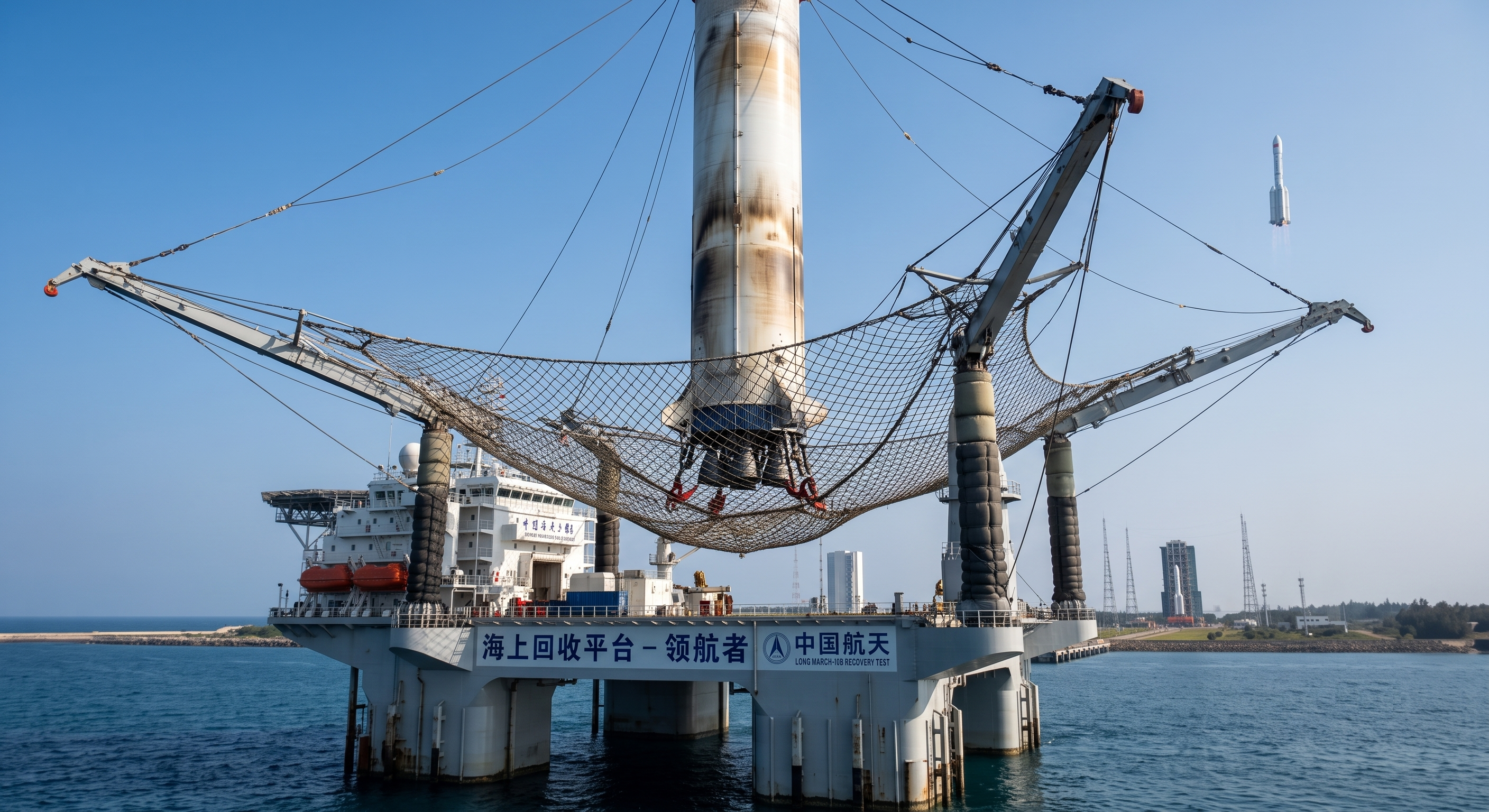
China's first orbital test of the Long March 10B rocket was a milestone for its space programme on Friday, as the first stage booster was successfully recovered.
The rocket took off at 12:15 a.m. Eastern from the Hainan Commercial Space Launch Site, and recovery of the first stage, with a net capture system on a sea platform, was confirmed by the China Aerospace Science and Technology Corporation 11 minutes later.
Mechanisms for Reusability, A Different Path
Whereas SpaceX's Falcon 9 and Blue Origin's New Glenn use vertical landing legs to land the vehicle, the Long March 10B uses a very different method. When the rocket falls, a hook mechanism is deployed and snaps into tensioned cables attached to the retrieval platform, while a mechanism automatically locks the rocket into place for transport.
CASC engineers state that this method has some unique engineering benefits. By integrating the rocket's structure with the addition of a net-based recovery system, it is easier to build the rocket, and the weight of the rocket is reduced, which also increases the amount of payload.
It is also very tolerant of landing-point deviations, which can be expanded by the use of coordinated net systems, CALT expert Chen Muye told Xinhua.
Strategic Significance
The mission was not just symbolic in nature. The feat marks China joining SpaceX and Blue Origin as the only companies to build and operate reusable orbital rockets — and the first time a SpaceX first-stage has successfully recovered the vehicle on its first flight.
The Long March 10B is not a project of its own. The successful debut seems to pave the way for the first flight of the crew-rated Long March 10A, for which an uncrewed Mengzhou spacecraft will be launched on a full-earth orbit mission this year.
China has made a pledge to bring astronauts back to the Moon before 2030, while America is planning for a crewed return to the Moon under the Artemis programme for 2028.
Implications for Global Launch Economics
The aim of reusability is to hit the core of the launch-cost economics. Using cheaper and reusable launchers, SpaceX has been able to beat its competitors and capture the commercial launch business — a model Beijing is looking to replicate.
CASC officials said the flight of the reusable rocket marked a big reduction in the cost of launching the missile and the recovery would be repeated later this year with the missile having a large payload capacity and being highly cost-effective.
The launch also comes at a time of renewed momentum in the private space sector in China. As private Chinese companies queue up for public offerings, the recovery lands as the world's biggest capitalist city is encouraging development of the technology.
Whether this net-capture model is repeatable, reliable and can be scaled up to repeated missions, as SpaceX's leg-landing model has been, will make or break whether China's model is a commercially viable option or just a one-off technical demonstration.
Latest News
- ◆Delhi Police Detain 100 With Criminal Records Before Protest
- ◆Contempt Plea in Supreme Court Over Delhi Transit Shutdown
- ◆Jantar Mantar Protest: Permission Denied, Curbs Imposed Across Delhi
- ◆Delhi Police Detain CJP Founder, Top Leaders Before Protest
- ◆Dhruv Rathee Detained Ahead of Jantar Mantar Protest in Delhi