
India, Switzerland Sign Five Key Agreements
India-EFTA pact targets $100 billion investment, 10 lakh jobs
Synopsis
India and Switzerland have strengthened their bilateral partnership with the signing of five agreements during Swiss President Guy Parmelin’s visit to New Delhi. The agreements cover migration and mobility, young professionals, transportation technologies, scientific research, and innovation and technology transfer.
India, Switzerland Sign Five Bilateral Agreements
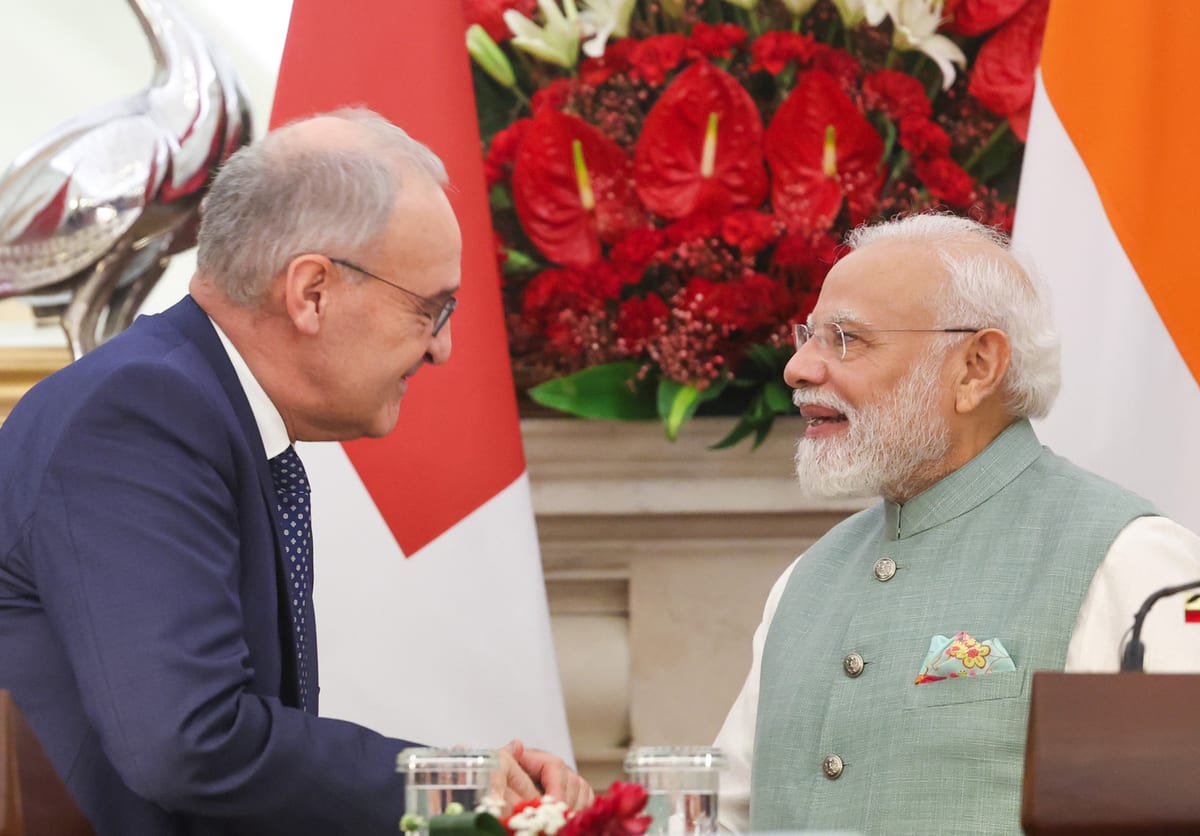
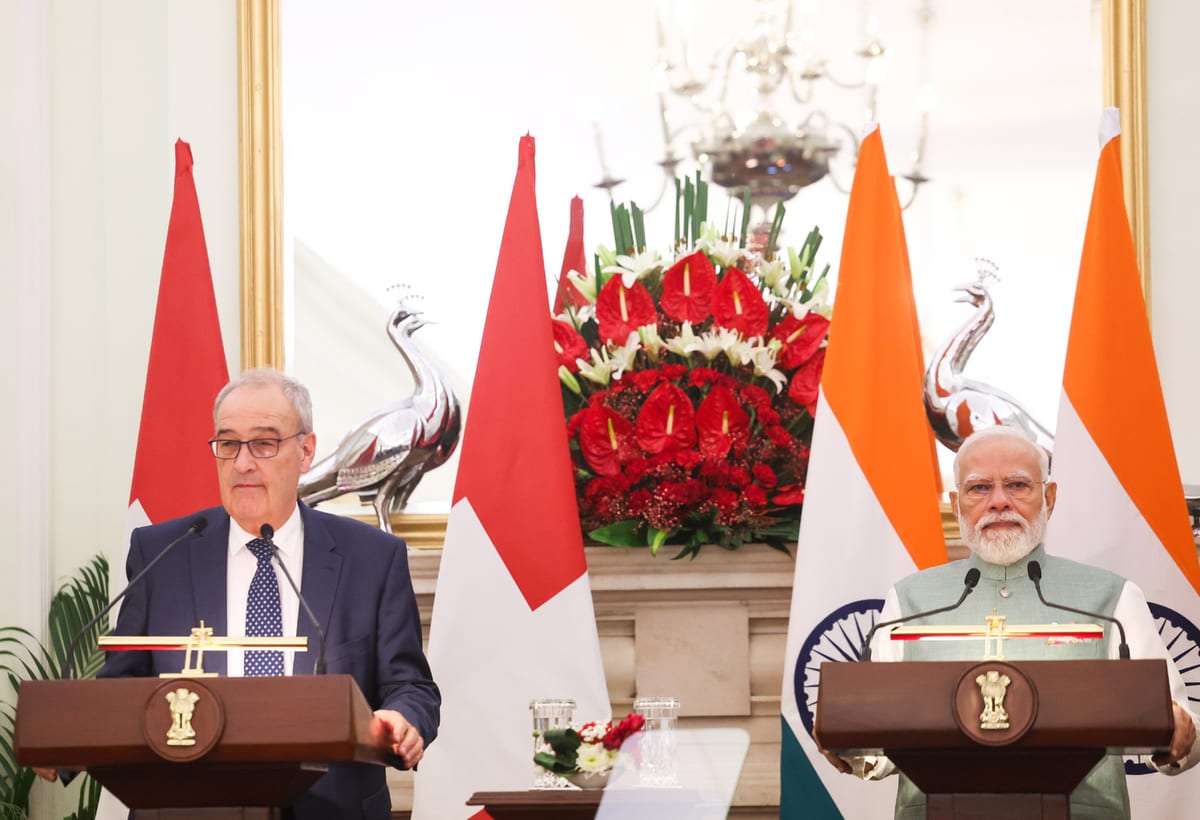
India and Switzerland signed five bilateral agreements on October 5, 2026, during the Swiss President Guy Parmelin’s visit to New Delhi. Followed by substantive discussions between Prime Minister Narendra Modi and the Swiss President, covering cooperation in trade and investment, particularly in the context of India-EFTA TEPA, where Switzerland is the largest trading and investment partner.
These agreements are on Migration and Mobility Partnership; an Exchange of Young Professionals, Promotion and Collaboration on transportation technologies; mobility systems and Infrastructure in identified areas Letter of Intent between Department of Science and Technology and Swiss National Science Foundation and Implementation Arrangement for cooperation in Innovation, Technology Transfer and Entrepreneurship.
Cooperation aims to increase exports of Indian agricultural products, pharmaceuticals, textiles and engineering goods, also enhance market access for Indian exports in Switzerland and further facilitate investment between the two countries in sectors such as biotechnology, life sciences, banking, insurance, food processing and sustainability. They have also agreed to further deepen cooperation in nuclear energy.
India Targets $100 Billion Swiss Investment
PM Modi appreciated Swiss President Guy Parmelin’s commitment to India-Switzerland relations. He described it as an ambitious framework for investment, innovation, employment and shared prosperity. He also highlighted that under the agreement, India aims to attract $100 billion in U.S. investment and create ten lakh direct jobs over the next 15 years.
Swiss President Arrives in India to Deepen Ties
President Parmelin arrived in New Delhi, India, accompanied by a high-level delegation comprising senior officials and business leaders. The visiting dignitary was accorded a ceremonial welcome at the forecourt of Rashtrapati Bhavan. President Droupadi Murmu and Prime Minister Narendra Modi welcomed the Swiss President. He was given a tri-services guard of honour.
Mr Parmelin said, the relationship between the two countries is built on shared democratic values, as well as on trust and mutual respect. Swiss President said that his visit is a stepping stone towards further growth, deepening and strengthening of our close, broad and long-standing partnership.
India, Switzerland Ink Five Cooperation Pacts
Both sides exchanged the following Memorandum of Understanding (MoU) agreements, and letters of intent signed during the visit: One, the MoU on Migration and Mobility Partnership.
1. Migration and Mobility Partnership
2. Exchange of Young Professionals.
3. Mobility between the Federal Department of Economic Affairs, Education and Research and the Ministry of Road Transport and Highways.
4. Letter of Intent between Departments of Science and Technology and Swiss National Science Foundation.
5. Implementation Agreement between Zurich University of Applied Sciences and Department of Science and Technology, our DST.
President was accompanied by members of Swiss Parliament, along with high-level delegation, including senior officials, State Secretaries, CEOs and representatives of major business houses in Switzerland, as well as the scientific and academic community, including presidents of universities and science institutions.
India-Switzerland Strengthen Trade, Infrastructure, Technology
Economic cooperation is the key pillar of India-Switzerland relationship. Switzerland is the India's 15th largest trading partner, to a bilateral trade of US more than $ 25 billion, and Swiss companies have invested in pharma, chemicals, precision engineering, machinery, logistics, financial services, and advanced technology. Around 340 Swiss companies are present in India, including some of the big names in the multinational companies.
Both leaders also focused on further collaboration in the field of infrastructure. There is an ongoing collaboration in this sector, with Swiss investment in the construction of railway bridges and tunnels in India, utilizing their experience and expertise.
Swiss company Fassler Engineering is involved in the construction of the Chenab Bridge in Jammu and Kashmir, which is the world's highest rail bridge. The Varanasi ropeway project, India's first urban ropeway transportation project in Varanasi has been built with Swiss technology from Bartholet, revolutionizing urban transportation in one of India's oldest and most sacred cities.
The Swiss company Flughafen Zurich has invested in the development of the Noida International Airport in Jewar, which has now become operational. Another important area of bilateral cooperation discussed is science, technology, and innovation, where cooperation is ongoing for several years. Switzerland has well-established strengths in advanced research, innovation, and high-technology sectors.
Discussions were held on strong institutional linkages through the Swiss-India Joint Research Programme, Swissnex India, and Swiss National Science Foundation, together with Swiss Government Excellence Scholarships.