
Meerut Blue Drum Murder: Wife and Lover Sentenced to Death
Two convicted for killing a former Merchant Navy Officer, in the infamous “blue drum” case
Synopsis
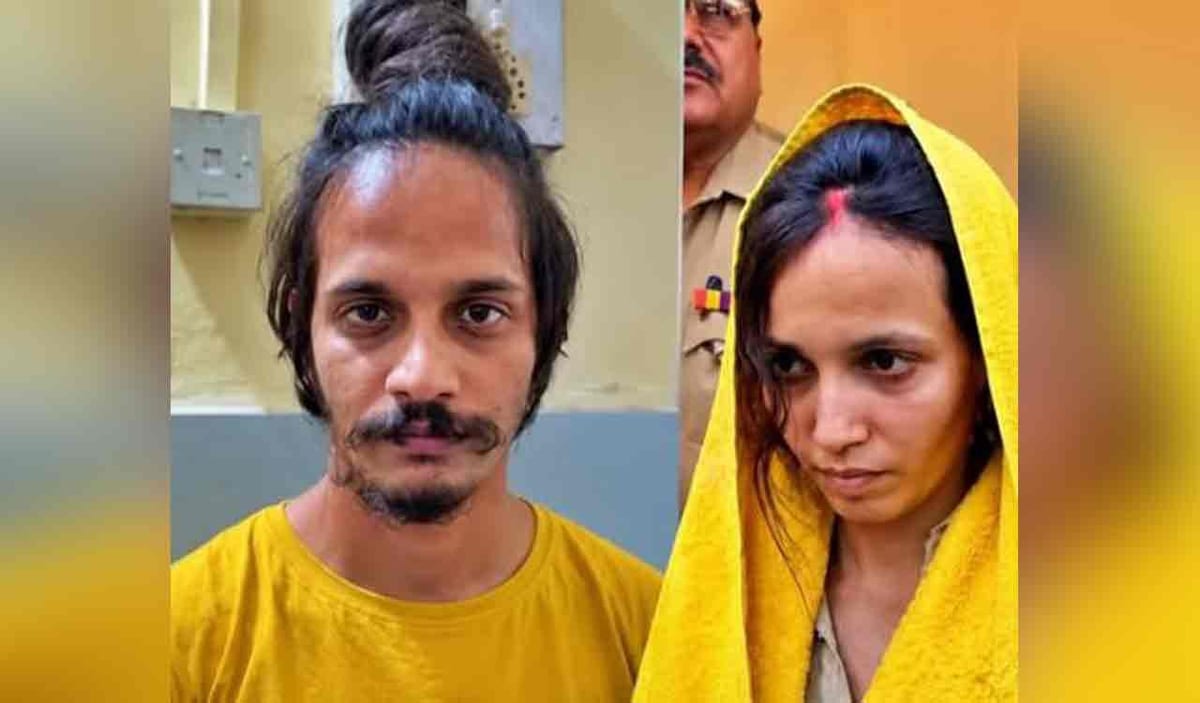
A Meerut district court on October 14, 2026, sentenced Muskan Rastogi and her lover Sahil Shukla to death for murdering her husband, a former Merchant Navy officer Saurabh Rajput. The couple allegedly drugged and stabbed the victim and then dismembered his body on March 3, 2025, and sealed the remains in a cement-filled blue drum. Following a 13-month trial the court convicted them on September 30, 2026. The Judge, Arvind Kumar Mishra, pronounced the verdict through a video conference. The sentence still has to be approved by the Allahabad High Court. Saurabh’s family has asked for maximum punishment, while Muskan’s parents have no objection to it.
Death Sentence for Both Convicts
The case finally ended on Wednesday , October 14 2026, roughly after eighteen months of the crime when District and Sessions Judge Arvind Kumar Mishra sentenced Muskan Rastogi and Sahil Shukla to death, after convicting them two weeks prior on September 30. Both followed the proceedings via video conference from within the prison. Advocate Krishan Kumar Dubey told ANI that apart from the death sentences, a fine of ₹50,000 under Section 302 and ₹20,000 under Section 238A, was also imposed on the accused.
It was reported that the judge also drew a parallel from the Mahabharata in court, describing punishment as a form of dharma. The sentence is not final; under Indian law, the Allahabad High Court must confirm it before it can be carried out.
The Victim, the Accused, the Home
Saurabh Rajput, a Merchant Navy officer based in London, returned home to Indira Nagar in Meerut on February 24, 2025, for his daughter’s birthday. Both the convicted are Muskan Rastogi, with whom the victim has been married since 2016, and Sahil Shukla, the man prosecutors described as her lover. Rajput and Rastogi were also parents to a six-year-old daughter.
The Killing and Its Discovery
Police allege that on March 3, 2025, Muskan had spiked her husband’s dinner with sedatives. Sahil then arrived at the house, and the two stabbed Rajput to death. Prosecutors told the court that they, after stabbing the victim, dismembered the body, buried the remains in a large blue plastic drum and filled it with wet cement and sand. It was reported that the body was cut into 15 pieces. The pair then, the next day, left for Himachal Pradesh. It was reported that Muskan used Saurabh’s phone to text his family, suggesting he was alive and travelling for work.
The circumstances on how the crime came to light vary. According to one story, some workers, who were hired to move the heavy drum became suspicious when its lid popped open and spilled a foul smell. Another says relatives and local authorities arrived at the house on March 17, 2025, after the couple’s daughter reportedly told neighbours, “Papa is in the drum.” Police denied the suggestion that the child had witnessed the crime.
Since no one had witnessed the killing, the case hinged mainly on circumstantial and scientific evidence. Shopkeepers testified that they had sold the drum, cement, sand, cleavers and razors to the duo. Call records and cell tower data placed Sahil at the house and tracked the couple’s trip to Shimla and Manali. The autopsy results confirmed that Saurabh had been stabbed. The accused were arrested within days and sent to jail on 19th march, 2025.
The Alleged Motive
Prosecutors claimed that Saurabh’s return became an obstacle to Muskan’s relationship with Sahil, and that the two conspired to get rid of him. It was said that Muskan had asked for a divorce and that Saurabh had refused. It was also reported that she created a fake Snapchat account posing as her deceased mother to persuade Sahil that the murder was meant to be.
The defence argued that since nobody saw the murder take place and the accused are both parents to daughters, the court must acquit them of the charges. Advocate Dubey for the prosecution said that the court set these arguments aside because the prosecution’s evidence was strong and precise.
Trial, Reactions and Aftermath
The trial was transferred to the district judge’s court in July 2025; the court’s session then lasted for about 13 months, which included 126 hearings and testimony from 22 or more witnesses. Police submitted a chargesheet of roughly 1000 pages, and final arguments were made on September 17. On the day of sentencing, Muskan’s parents in a written statement
expressed that they would not oppose the death penalty. Saurabh’s family had asked for the harshest punishment, and his mother, Renu Rajput, urged unhappy couples to part ways amicably rather than resort to violence. Lawyers outside the court described the case as “rarest of rare”.
Moreover, the jail authorities reported that both convicts ate very little food before the sentencing and are under constant surveillance. Muskan, reportedly, has stopped interacting with other inmates and has asked to see her younger daughter, who was born in prison.