
No PUC, No Fuel: Gurugram Puts 1,054 Sites Under Watch Before Winter
A fuel-denial rule due from October 1 arrives with Haryana's NCR districts behind schedule on cameras, monitors and buses as of August
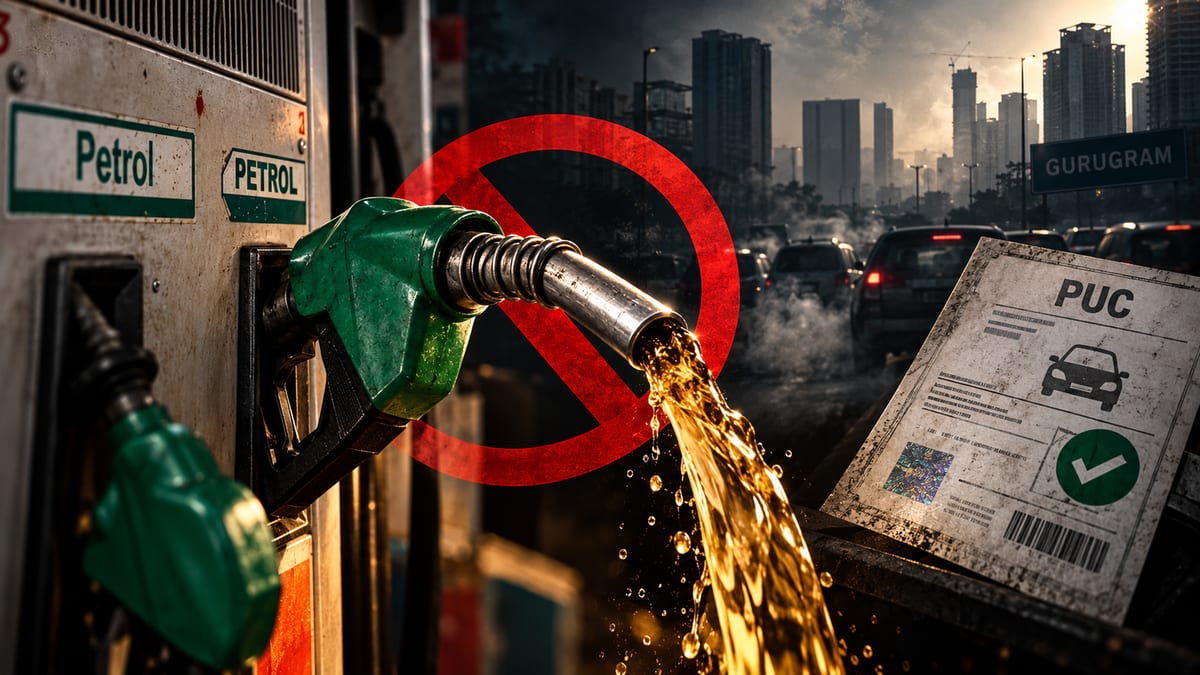
The District Coordination Committee, Gurugram, has instructed to refuse fuel to vehicles without Pollution Under Control certificate and electronic monitor 1,054 construction sites since they are not permitted to operate beyond their age. The measures come on the heels of a directive issued by the Commission for Air Quality Management in the NCR for the enforcement of these measures from 1st October. In August, the Tribune reported on its findings from a "state review meeting" that cameras, monitors and buses were falling behind targets, so the test would now be on implementation.
A fuel pump turns into a checkpoint!
The directions were given during the 13th District Coordination Committee meeting on Tuesday, 29 September. The chairperson of this was D.S. Dhesi, Principal Advisor, Government of Haryana in Urban Development. Vehicles exceeding the prescribed age will not be permitted to purchase petrol or diesel in Gurugram and such vehicles that are not equipped with a valid PUC certificate won't be allowed to buy fuels.
This is a local rule. A direction from the Commission for Air Quality Management will be issued, allowing for dispensing of fuel only with the production of a valid PUCC from October 1, 2026 across the NCR. Delhi has been working to the same principle. It will start enforcing its "No PUC, No Fuel" policy in December 2025.
Cameras are the key to enforcement. The system reads a car's registration plate and compares it as it scans the car in real time to the pollution certificate database before dispensing fuel.
In the first phase, Haryana has planned 775 cameras, of which 249 are to be installed in Gurugram, under a project that will cost ₹41.7 crore, and is due to be installed by 30 September. The technology would help in "effective identification of old vehicles," says Transport Minister Anil Vij.
Watching construction dust
The second part of the plan is monitoring of sites. A report of the meeting stated that web cameras had been installed at 907 of 1,054 construction sites identified for monitoring and sensors at 534.
Web cameras and low cost sensors to connect with the Commission and the pollution department are required for sites larger than 500 square metres. The UNI report calls the 1,054 more generally "pollution-emitting sites.
The failing of the foundations
Records of a review held between Chief Minister Nayab Singh Saini and Union Environment Minister Bhupender Yadav showed that the preparations were incomplete, the Tribune reported on 2 August.
Only 22 out of 45 fuel stations and 45 air quality monitoring stations were installed as of June 30 and there were no ANPR cameras installed at 2,780 fuel stations, respectively.
Of the 875 targeted electric buses, 70 were in service and there was no service in Gurugram and Faridabad, which have a combined target of 600 buses.
Gurugram had achieved 228 km of destruction of roads in the season, out of 494.92 km in the NCR Haryana, as well as 399 winter burning cases, the most of any NCR district this season.
In June, officials in the state set a new goal. The bus fleet will be increased to 925 e-buses by 2026, with 23 more monitoring centres set to be operational before 30 September, Additional Chief Secretary (Transport) Rajasekhar Wundru said. These are records prior to the September deadlines and I was unable to ascertain on-going progress.
The precedent is set in other parts of the NCR. Delhi started its rule and the Delhi Petrol Dealers' Association (DPDA) revealed that technical problems were delaying the process, with the ANPR cameras not working to detect PUC-less vehicles until the afternoon at several petrol stations.
Why the season matters
The Delhi government has reported that the average AQI of the city during the last three winters has been in the range of 312-342, with maximum upto 461-494.
For about six to seven months, vehicular emissions continue to be one of the significant sources throughout Gurugram, Faridabad and the entire NCR. A UNDP action plan for Gurugram, covering 2025-2030, lists vehicular emissions and construction among the main drivers of its air pollution.
What comes next
The Rules and deadline are set by the officials. The things that are making a difference now are the testing of cameras at pumps, live feeds from sites and buses on the road ahead of the first smog days.
Latest News
- ◆No PUC, No Fuel: Gurugram Puts 1,054 Sites Under Watch Before Winter
- ◆₹9,222 Crore in Cess Never Reached Its Designated Funds, PAC Notes
- ◆Starship Reaches Orbit for the First Time and Deploys 26 Starlink Satellites
- ◆Supreme Court Refuses to Stay UPI Merchant Charge, Notice Issued to Centre
- ◆Gandak Reaches Record 91.25 Metres, Breaching Embankments in Bihar and Uttar Pradesh