
BJP's Historic Breakthrough in West Bengal
The Bharatiya Janata Party ends 15 years of Trinamool Congress rule, becoming the first right-wing party elected to govern West Bengal
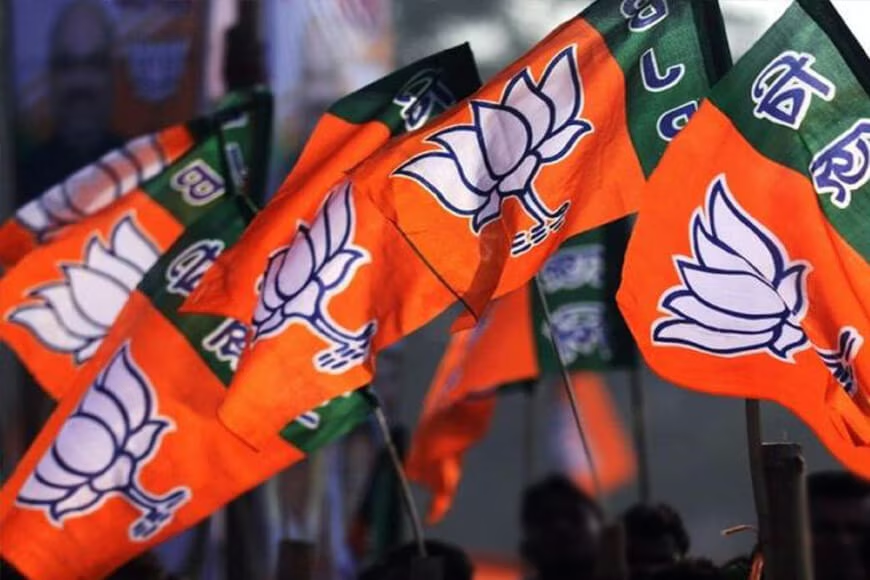
Synopsis
The Bharatiya Janata Party has won the 2026 West Bengal Legislative Assembly elections, defeating the All India Trinamool Congress after 15 years in power and marking the first time a right-wing party will govern the state. Results for 293 of 294 seats were declared on 4 May 2026 following a two-phase vote on 23 and 29 April, in what was recorded as a historic 93 per cent voter turnout.
The End of a 15-Year Ascendancy
For fifteen years, West Bengal's political landscape was defined, in its essentials, by a single figure: Mamata Banerjee, and the party she built from a Congress splinter group into the dominant force in one of India's largest and most electorally complex states. The All India Trinamool Congress first swept to power in 2011, ending 34 years of Left Front rule. It consolidated that hold in 2016 and 2021, when the Trinamool secured 215 of 294 seats.
That era ended on 4 May 2026, when the Election Commission of India announced results for 293 of the 294 constituencies. The BJP — which has governed at the Centre under Prime Minister Narendra Modi since 2014 but had never previously held state power in West Bengal — emerged victorious, becoming what Wikipedia's contemporaneous account describes as "the first right-wing party to be elected to rule in the state."
The election was conducted in two phases on 23 and 29 April 2026, with counting day returning a result that analysts had regarded as plausible but not assured, given the Trinamool's formidable organisational machinery and Banerjee's personal hold on large sections of the electorate.
The Mechanics of an Extraordinary Turnout
The election was distinguished by a voter turnout of approximately 93 per cent — a figure that surpassed even the celebrated 2011 election that brought Mamata Banerjee to power. Officials and analysts pointed to multiple factors: heightened political mobilisation in an election framed as a referendum on 15 years of Trinamool governance, and — notably — unusually high participation in urban centres, including Kolkata, where historically low turnout had been a consistent feature.
The Election Commission of India had announced the electoral schedule on 15 March 2026. One constituency, Falta, was excluded from the 4 May results due to severe electoral offences; a re-poll is scheduled for 21 May 2026, with results on 24 May.
A number of political observers noted the role of migrant labourers who returned to the state from other parts of India to exercise their franchise — a pattern reported extensively in local media, including through a viral video from Gujarat that the Trinamool alleged constituted a breach of the Model Code of Conduct.
The Special Intensive Revision Controversy
The 2026 election will be remembered as much for its pre-poll controversies as for its outcome. The most consequential of these was the Special Intensive Revision (SIR) of electoral rolls conducted ahead of the election, in which approximately nine million voter entries — representing roughly 12 per cent of the state's electorate — were removed from the rolls.
Over six million of those removed were categorised as absentee or deceased; the status of an additional 2.7 million remained pending before tribunals. The process attracted intense political and judicial scrutiny. In February 2026, the Supreme Court directed the Calcutta High Court to appoint judicial officers to oversee the SIR exercise; 150 district and sessions court judges were subsequently engaged.
The Trinamool argued that the SIR risked disenfranchising genuine voters, particularly Muslims and residents of border areas with complex citizenship histories. The BJP defended it as a necessary cleansing of fraudulent entries and the removal of illegal migrants from the rolls. Critics of the exercise described it as an erosion of democratic norms; its supporters called it essential electoral hygiene.
Campaign Issues and the Verdict of Anti-Incumbency
The campaign was fought on several distinct axes. Governance and anti-incumbency formed the principal terrain. The BJP foregrounded job creation, delayed recruitment examinations, and a recruitment scandal that had dogged the state administration for years. The Trinamool countered with its record on welfare schemes — including a range of cash transfer programmes that had broadened its electoral coalition — and promised continued investment and infrastructure expansion.
The Citizenship Amendment Act also featured in the campaign, particularly in constituencies where refugee politics and the Matua community — a large scheduled-caste Hindu group with roots in Bangladesh — carried electoral weight. BJP leaders pledged to accelerate citizenship processing under the CAA in a BJP-governed West Bengal.
Border security and undocumented migration from Bangladesh were additional campaign issues, particularly in districts adjoining the international border — a zone where demographic anxieties and identity politics have historically intersected with electoral mobilisation.
The Political Geography of the Result
The BJP's victory marks a fundamental reordering of West Bengal's political map. The state, which had been governed by the Communist Party of India (Marxist) for 34 continuous years before 2011 and by the Trinamool for the following 15, now enters a period of BJP governance for the first time in its post-Independence history.
The result also signals the return of other parties to the assembly. Both the Indian National Congress and the Communist Party of India (Marxist) — which had been shut out of the legislature entirely in the 2021 elections — returned to the West Bengal assembly.
National Implications: Modi's Coalition and the Opposition Map
For Prime Minister Narendra Modi and the BJP's national organisation, the result is of considerable political consequence. West Bengal — with its 294 assembly seats and 42 Lok Sabha constituencies — has long represented an elusive prize for the party. The state's heterogeneous electorate, its Bengali cultural identity, and the Trinamool's entrenched organisational network had consistently frustrated BJP attempts at full electoral conversion.
The 2026 result will test the BJP's capacity to translate legislative victory into governmental performance in a state with a distinct administrative culture, complex social fault lines, and a political opposition that, while defeated, is likely to reorganise for the next electoral cycle. For Mamata Banerjee, the loss closes a significant chapter — though the Trinamool, as a regional party with deep grassroots reach, retains the infrastructure for an eventual political return.