
China’s Private Space Industry Has Big Ambitions
The Chinese Space programmes
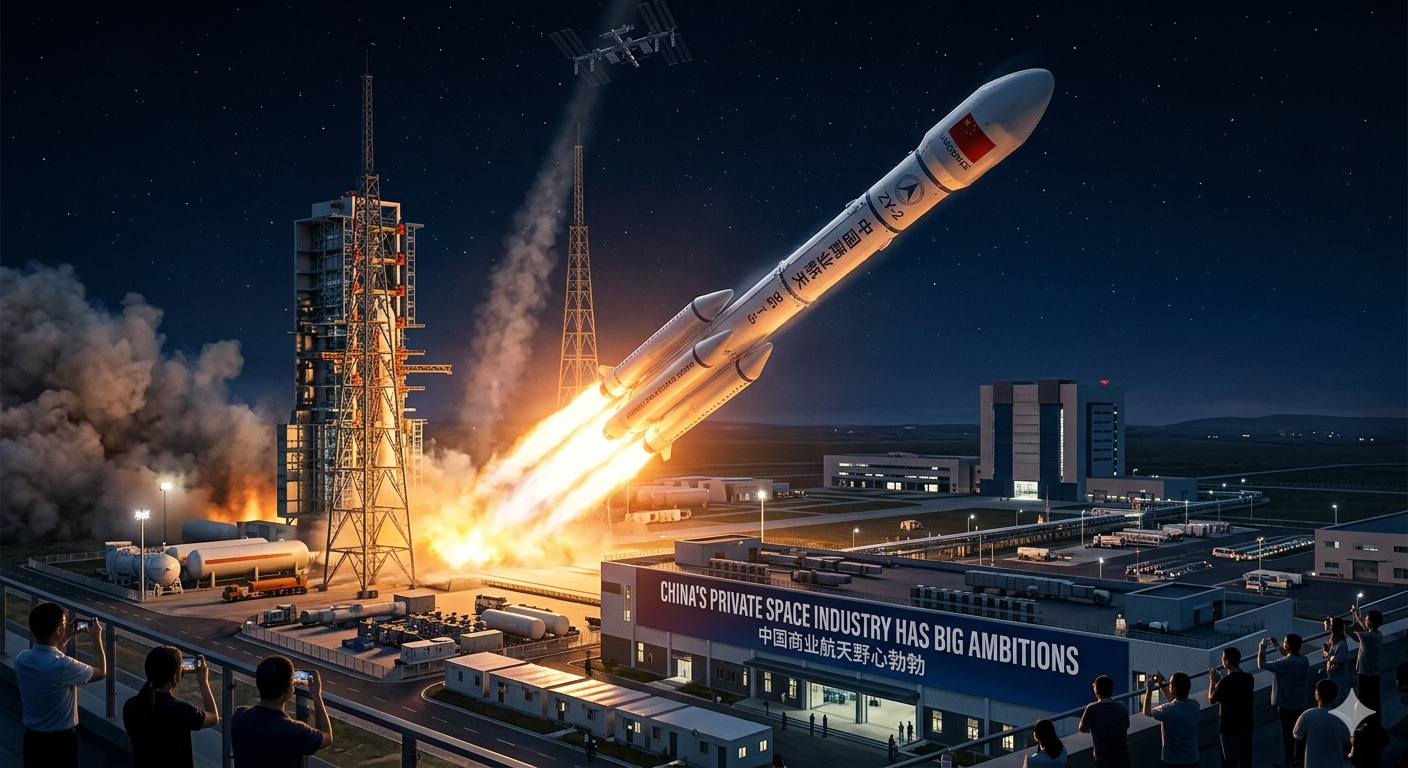
Over several decades, the space programme of China was largely a state prerogative, driven by strategic need, and implemented by large, state-owned aerospace conglomerates. The said paradigm is currently in the process of change. It has experienced a recent emergence of a new generation of Chinese enterprises in the space sector, which has been thru the success of SpaceX in the United States, to a large extent. These companies are ambitious, well-capitalised, and increasingly central to the long-term agenda of Beijing in positioning itself as a leading space power.
The break-even point came in 2014 when the Chinese government officially opened up portions of the space industry to private capital. Since then, dozens of start-ups have taken the field with the major focus on launch vehicles, small satellites, and downstream uses, including Earth observation and communications. The companies LandSpace, iSpace, Galactic Energy, and CAS Space have come to represent this movement and are often referred to by the media and analysts as the China SpaceX moment.
The main aim of their ambition is to achieve cheaper, more frequent and reliable access to orbit. SpaceX has revolutionized the international launch market with reusable rockets and struck the international launch market with the lowest costs. These modern Chinese private companies would strive to achieve a similar upheaval, though in a much different political and industrial environment. These Chinese start-ups are closely related to the apparatus of the state, even though the SpaceX path was established by far, being outside of the normal aerospace establishment, they are supported by the policy and have access to state-owned supply chains, as well as government contracts.
The advancement has been rapid in terms of technology. The private Chinese companies in recent years have managed to launch several orbital launches, something that would have been unthinkable a decade ago. An example is Galactic Energy Ceres-1 rockets, which have had a successful mission series that made it one of the most trusted private launchers of China. The Zhuque-2 rocket of LandSpace has attracted worldwide attention as the first methane-liquid oxygen rocket in the world to enter orbit, and is another engine option similar to the SpaceX Starship, and is considered to be central to reusability in the future.
Reuse has become the holy grail of the industry. A number of Chinese firms are currently experimenting with vertical take-off and vertical landing (VTVL) technologies, and openly aping SpaceX with the Falcon 9 booster landings. Experimental hop tests, grid fins, and landing legs are no longer props but are normal features in prototype configurations. Though reusability at scale is still years off, the trend is clear.
However, more than just rockets, being better than SpaceX. The dominance of SpaceX is based on vertical integration and the Starlink satellite constellation that gives the company a revenue stream and strategic flexibility. The Chinese companies are trying to follow this example. There have been several low-Earth-orbit mega constellation projects announced, both funded by private funds and others by agencies affiliated with the state. The objectives of these constellations are to facilitate broadband connection, remote sensing and industry, and at the same time, reduce the reliance of China on the services offered by foreign satellites.
Although pushed behind, major hurdles still persist. The regulatory environment of the Chinese private space companies is also more limited than that of the US. Sharing of technology with its foreign partners is minimal, and there are export controls, both at the domestic and international level, that limit access to some of the advanced components. In addition, there is intense competition even in China, complete with overlapping projects and the constant threat of overcapacity.
There is also the issue of tension between innovation and imitation, which is to be examined. Opponents argue that most Chinese start-ups are simply doing what SpaceX did and not blazing new trails. However, history tells us that rapid adopters, supported in large numbers by the state, can close the technological divide within a very short period.
Finally, the Chinese space private market is not only trying to copycat SpaceX but wants to make sure that no country can put China at a strategic disadvantage in orbit. These companies are becoming part of the larger Chinese space programme as launch cadence is settled, satellite networks grow, and reusability is settled. The race is not over, but one thing is obvious: the private space industry in China is no longer experimental; it is focused, competitive and is on its way to survival.