
One Nation, One Election–The Indian Political Saga
A Radical Roadmap to align the Democracy of India
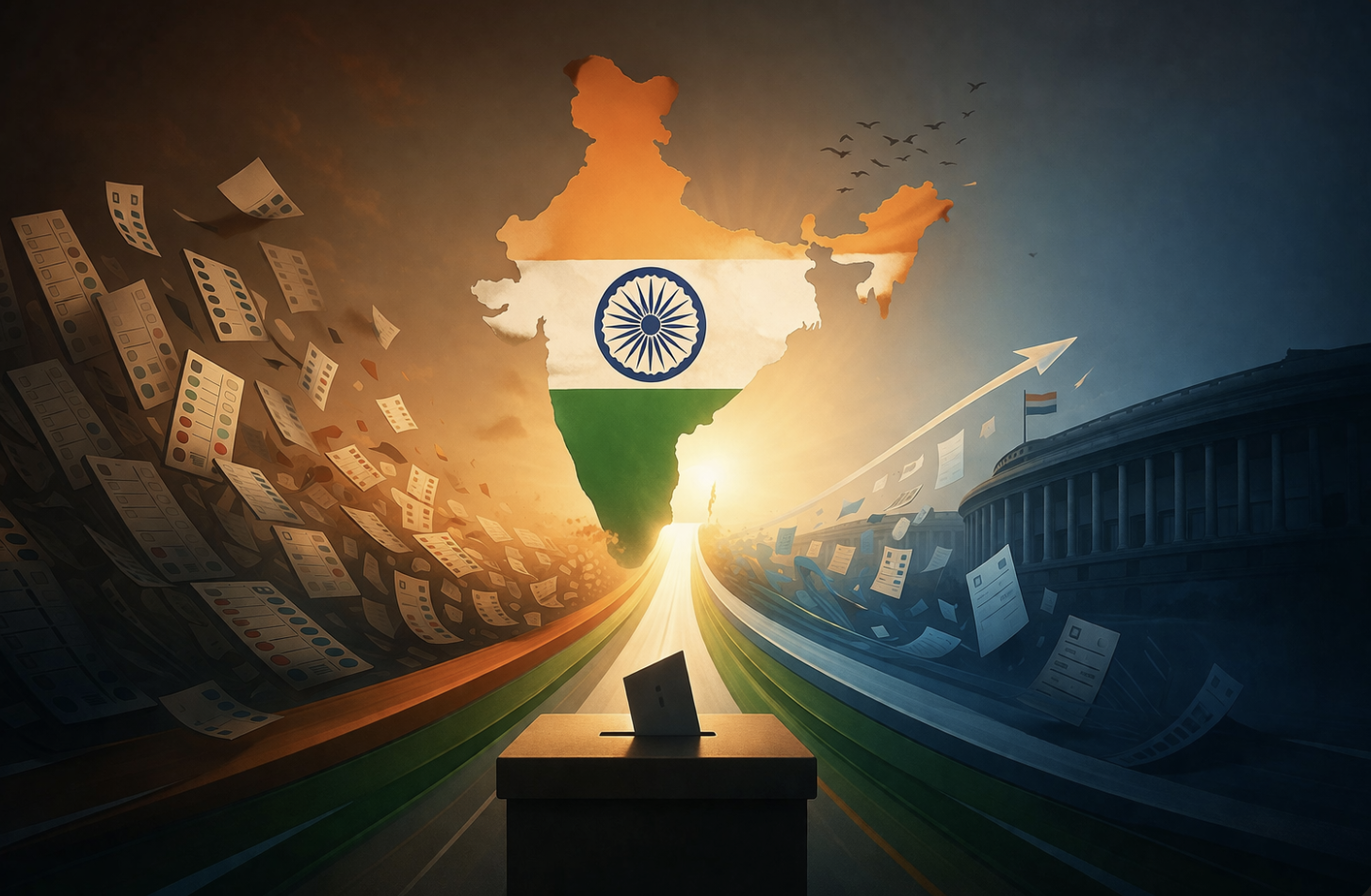
One Nation, One Election (ONOE) is not a new development, and more of reconceptualization of India’s traditional electoral politics. Over the first two decades of the Republic, i.e. the years 1952, 1957, 1962, 1967, the Lok Shaba and the State Legislative Assemblies worked in the same concurring beat. Premature dissolutions in 1968 and 1970 broke that balance and were then followed by repeated activations of Article 356, and subjected India to a long period of electoral mobilisation.
Today, ONOE suggests the unified synchronisation, the Lok Shaba, the State Legislative Assemblies, and the third level of the local government, i.e. municipalities and panchayats.
The Two-Phase Strategy and Kovin Committee
Modern popularity of the suggestion was triggered by the High-Level Committee (HLC), under the chairmanship of former President Ram Nath Kovind. The HLC suggests two stages of implementation: Phase One: Co-ordination of the Lok Shaba and the State Legislative Assemblies. Phase Two: The implementation of local-body elections in 100 days of a general poll.
The Architecture of the Constitution and the Law
In order to make this framework operational the proposed 129th Amendment Bill proposes important procedural triggers. Article 82A (1) gives the President the authority to publish an Appointed Date after a general election; any State Assembly elected after the date under Article 82A (2) will serve a term automatically terminated by the end of the federal clock: the Lok Shaba. Phase One is the one that can be done by Parliament, whereas Phase Two, which is related to local bodies, must be ratified by a majority of State Legislatures under Article 368(2) as it involves State Election Commissions and local governing bodies.
The Logistical Mountain
The Election Commission of India (ECI) is faced with a daunting EVM-VVPAT Challenge. Currently, the ECI is staggering voting equipment in staggered polls. Application of ONOE would require doubling of inventory, which is increasing to 1.36 million polling stations as compared to 1.18 million polling stations.
Use of Central Armed Police Forces (CAPFs) stands out as an important bottleneck in logistics. The necessity to attend to more than one million booths within one day puts tremendous demands on national internal-security preparedness.
Federalism and the Basic Structure Debate
According to the criticism, ONOE can be in violation of the Basic Structure Doctrine developed in the Kesavananda case. Opponents believe that state governments might be turned into administrative appendages of the Union by forcing them to fit into a national narrative. Empirical evidence gives some credence to the fears about political plurality: studies show that voter choice of same party to elect state and centre-level converge at a rate of 77 when they are held together by 6 months, compared to 61 when they are separated. This convergence has the risk of giving more priority to national than regional imperatives that may impact on the security and macro-economic stability. Besides, which has been Art. 356 to park a state between cycles is also incompatible with the S.R. Bommai case, which limits Presidential Rule to real failures of constitutional machinery.
The Governance Rationale: What Is the Rationale?
In spite of legal obstacles, the efficiency arguments are still convincing: 1. Fiscal Savings: The 2019 election was ₹60,000 crore; ONOE has a potential of increasing GDP in India by 1.5 per cent in one go-round. 2. Policy Paralysis: The Model Code of Conduct (MCC) stops developmental projects in India in an almost continuous manner at present; ONOE ensures for four and a half years of continuous government. 3. Administrative Focus: Teachers and officers would have time to back to the key tasks other than wasting time in election duty.
Transition to 2029
The roadmap envisages 2029 as the first complete circle. This would necessitate such harmonisation of terms as a state elected in 2027 would voluntarily or compulsorily shorten its tenure in 2029. Finally, ONOE can be considered a litmus test to Indian federalism; its effectiveness will be based on the ability of the Union to find political compromise and resist the unavoidable judicial checks.