
India-New Zealand Free Trade Pact To Take Effect October 20
The agreement offers duty-free access to 100% of Indian exports from day one, as both nations diversify trade amid global tariff volatility
Synopsis
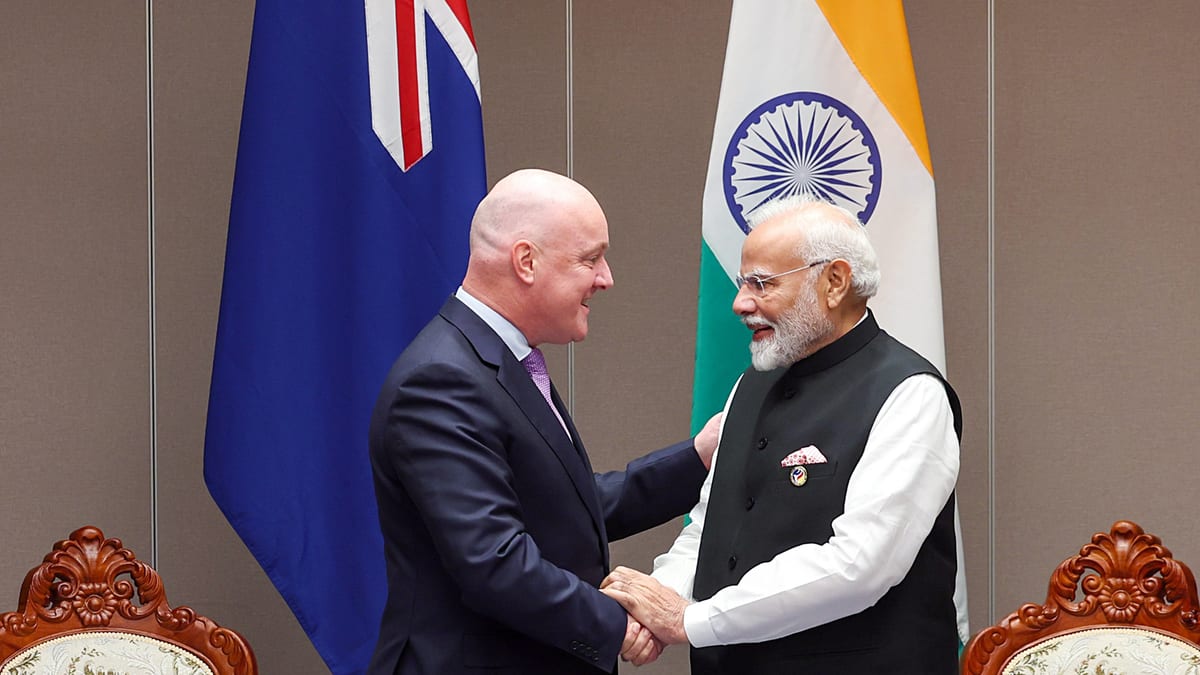
India-New Zealand Free Trade Agreement will enter into force on October 20, says New Zealand Prime Minister Christopher Luxon after parliament approves the deal.The India-New Zealand Free Trade Agreement will be activated on October 20, announced the Prime Minister of New Zealand Christopher Luxon after the parliament approves the agreement. The agreement will give Indian exporters duty-free access from day one to all New Zealand tariff lines and will provide New Zealand products access to India markets over time with dairy and a limited number of agricultural products still covered.
The Announcement
As countries look for new trading partners in the wake of the uncertainty of US trade policy, India will implement free trade with New Zealand on October 20. Parliament has approved legislation that enables New Zealand's government to sign the agreement which, after passing in Parliament, was ratified by Prime Minister Christopher Luxon. In a previous interview, Luxon has said the deal is a “once-in-a-generation” opportunity for New Zealand exporters.
Piyush Goyal, Minister for Commerce and Industry, confirmed this and said that it is a symbolic time. Goyal said that the India-New Zealand Free Trade Agreement will enter into force on the auspicious occasion of Dussehra on 20th October 2026, and this is the next big step in the bilateral economic partnership.
What They Each Win
The duty-free access to India is expected to be for textiles and apparel, leather and footwear, engineering goods, pharmaceuticals, automobiles and auto components, agriculture and processed foods, and 100% duty-free starting from day one, said Goyal.
Tariff reduction or elimination will apply to around 95% of New Zealand's exports to India, by value, over the implementation period, with 57% of New Zealand's exports tariff-free from day one and commitments to be phased in to provide tariff-free access to 82% of all NZ exports by value. In India, sensitive industries like dairy and some agricultural products are still protected.
Genesis Of The Deal
The formal negotiations began in March 2025 with a bilateral trade exceeding a dollar billion between April 2024 and January 2025, and culminated in a meeting between Goyal and then New Zealand Trade Minister Todd McClay.
Four rounds of negotiations took place during 2025 preceding closing. The two leaders jointly announced that the deal has been completed that they believe will see bilateral trade increase two-fold over five years and New Zealand investments grow to $20 billion over 15 years.
Piyush Goyal, Union Minister for Commerce and Industry, said that 100 per cent of exports to NZ will be duty free from day one.
Why It Matters
As the world is changing its trading dynamics because of the uncertainty of US tariffs, the FTA is coming at a time when midsize economies are looking for partnerships to diversify.
The agreement, as one of India's quickest concluded FTAs, marks a continuation of the government's ambitions to increase market access for jobs-intensive areas such as textiles and leather, while also bolstering the overall positioning of ‘Viksit Bharat 2047’ trade agenda for India.
More opportunities for New Zealand to access the Indian market in dairy, horticulture and wool products will provide an alternative to its over-dependence on China as an export market.
Outlook
Now, with the implementation scheduled for October 20, the focus will be on how fast exporters on either side will be able to operationalise the new tariff schedules and whether the investment flows that the two governments have forecasted will occur on those timelines.
Latest News
- ◆NSE's $2.3 Billion IPO Draws Over $10 Billion In Bids
- ◆India-New Zealand Free Trade Pact To Take Effect October 20
- ◆Tata Group Governance Feud Deepens Over Chandrasekaran's Term
- ◆India Reaffirms Push For Constructive Ties With Bangladesh
- ◆Teen Gang-Raped Near Delhi Temple, One Suspect Held In Encounter