
Putin and Xi Cement a Durable Alliance in Beijing
Russia and China extend a landmark friendship treaty and deepen energy ties as Beijing cements its role at the centre of global diplomacy
Synopsis
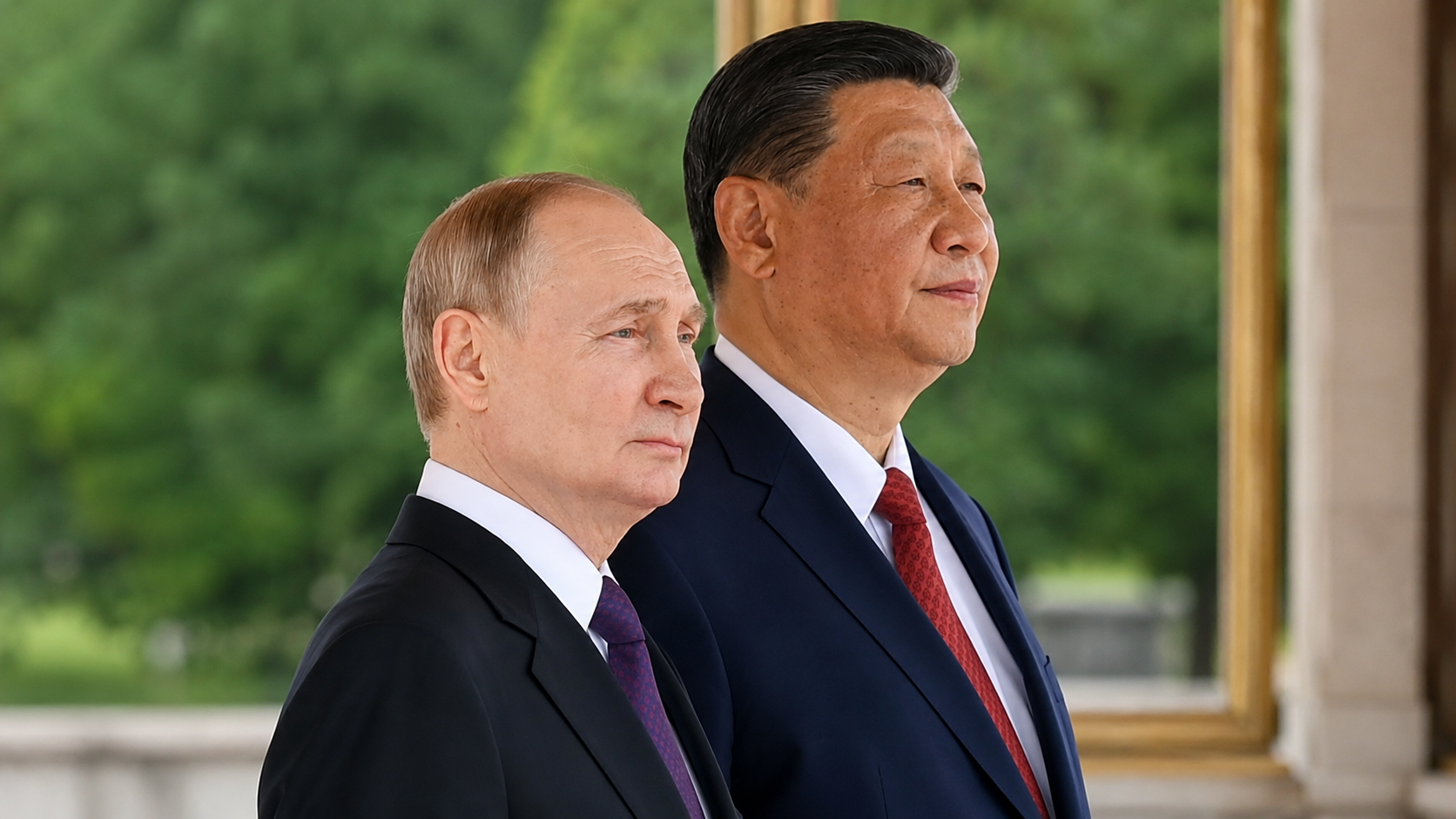
Russian President Vladimir Putin arrived in Beijing on 19 May 2026 for a two-day state visit — his 25th trip to China — meeting President Xi Jinping at the Great Hall of the People on 20 May. The two leaders extended their 2001 friendship treaty and reaffirmed bilateral energy and strategic cooperation, with Russia's oil exports to China having risen 35 per cent in the first quarter of 2026.
A Summit Bookended by Great-Power Diplomacy
The leaders of the two most important rival powers came to the Chinese capital in six days. On 15 May, President Xi Jinping of China and President Donald Trump of the United States held a bilateral summit, which was later followed by a four-day state visit to Beijing by Russian President Vladimir Putin on 19 May 2026, as described in the Chinese state media as a ‘state visit of extraordinary strategic significance'.
The two meetings were closely watched by foreign ministries in three continents, revealing Beijing's emerging role as the "indispensable interlocutor" in an era of multipolarity, as analysts increasingly term the current world, in which no single power is able to dominate.
A red carpet ceremony, military guard of honour and the playing of the national anthems marked Putin's landing at Beijing Capital International Airport, which was greeted with a full ceremonial reception.
The Treaty Extension and Its Geopolitical Weight
The main topic of the diplomatic agenda was the extension of the Treaty of Good-Neighbourliness and Friendly Cooperation (2001), which had served as the foundation for Sino-Russian cooperation for 20 years. The extension was confirmed by the Chinese state media, as the leaders are set to sign a slate of some 40 bilateral deals covering energy, tourism, education and defence coordination.
Putin used the bilateral talks to remind Xi of that in his opening remarks, in which he stated that “even in the context of the negative external effects, there is strong momentum in our interaction and economic cooperation.” The line was picked up by many analysts as a reference to Western sanctions against Moscow since Russia's full-scale invasion of Ukraine in February 2022.
In his turn, Xi described the world today as "increasingly chaotic" and called for a "fairer and more equal system of global governance. Both leaders used the term 'law of the jungle' — a term that has now become diplomatic jargon, in Beijing and Moscow, for the unilateral exercise of Western power.
The Partnership will be driven by energy
The main thread of conversation continued to be energy. Russia's oil supplies to China increased 35 per cent in the first quarter of 2026, a Russian presidential aide has said. Putin himself likened the energy sector to "the driving force of economic cooperation" in the bilateral partnership, saying that "practically all the key issues have been agreed upon" on a new gas cooperation framework.
Energy is a truly strategic dimension that is not to be left out of bilateral negotiations. Russia has had a strategy to divert its crude oil, LNG and coal exports since February 2022, moving them to China and India, where many of its trading partners have not imposed sanctions on its energy supply. Russia's crude has been the largest source of energy imports to China, and is now a growing proportion of China's refinery throughput.
“Russia is in desperate need for money to replace all that dried up Ukrainian gas, and that's their message from Russia,” said Al Jazeera's Beijing correspondent Katrina Yu.
The relationship between symmetry and asymmetry: A Strategic Partnership
The exact nature of Sino-Russian relations — equal partners or one "in which China now occupies the structurally dominant position" — has been subject to debate for a long time. This summit brought the question back to the fore.
Marina Miron, a postdoctoral researcher in defence studies at King's College London, told Al Jazeera that there is not likely to be a major change in the relationship: "I don't think that there is going to be a major shift. Others pointed to the fact that the summit was likely to reinforce cooperation, rather than spark new strategic moves.
On the sidelines of the summit, Russian Foreign Minister Sergey Lavrov also met with his Chinese counterpart Wang Yi and discussed the subject, highlighting the increasing institutional dialogue between the two countries' foreign policy establishments.
In addition, Xi also took the opportunity to champion China's 'four-point proposal' for the Middle East, which is focused on peaceful coexistence, respect for national sovereignty, international law, and integrated approaches to development and security.
How Beijing is increasingly leveraging its power in the fragmented world-order. Beijing's new diplomatic tools in a fractured world order.
The larger message of this week's summitry did not go unnoticed. To Xi, the leaders of both the United States and Russia were being hosted in quick succession is a "diplomatic flex," analysts said, a sign of Beijing's ability to play rival powers off each other.
Katrina Yu of Al Jazeera quoted ‘depth of established trust' between Beijing and Moscow that simply does not exist between China and the US. Meanwhile, she said, Xi is working on a more comprehensive goal: "calling for a more multipolar world, where the US has less power and influence.
It marks Putin's 25th visit to China, suggesting the level at which the two leaders' regimes have intertwined the narrative of their bilateral ties into their national political narratives.
Looking Ahead
Moscow will not be able to make much headway in addressing the underlying contradiction between its requests for improved cooperation from China (including, apparently, military aid) and Beijing's effort to maintain a 'neutral' role in the Ukraine war.
While China has been regularly conducting bilateral trade and strategic relations with Russia, it has always insisted that it is not involved in the conflict.
The summit makes it clear, however, that whatever happens between China and Washington – the two powers debate whether their relationship is a partnership or a competition – the China-Russia entente is a lasting fact of life for the international community as long as it is formalized in treaty renewals, energy contracts and joint military exercises.
Perhaps the most important geopolitical happening of this moment is Beijing's emergence as the meeting point of the world powers in a world that is on the verge of wars, sanctions and the gradual restructuring of post-Cold War institutions.
Latest News
- ◆Nobel Prize in Chemistry Awarded to Kagan and Soai
- ◆Saudi Arabia Steps Up Yemen Campaign as Houthi Fighting Reaches Bab el-Mandeb
- ◆Sensex Sheds 429 Points, Nifty Falls 0.8% After RBI Rate Hike
- ◆Forex Reserves Fall Over $50 Billion From Peak as RBI Defends Rupee
- ◆Rupee Hovers Near Record Low as RBI Governor Cautions on Market Irrationality