
Ted Turner, CNN's Visionary Founder, Dies at 87
The pioneering media magnate and philanthropist died after a prolonged battle with Lewy Body Dementia, leaving behind a transformative legacy in global broadcast journalism
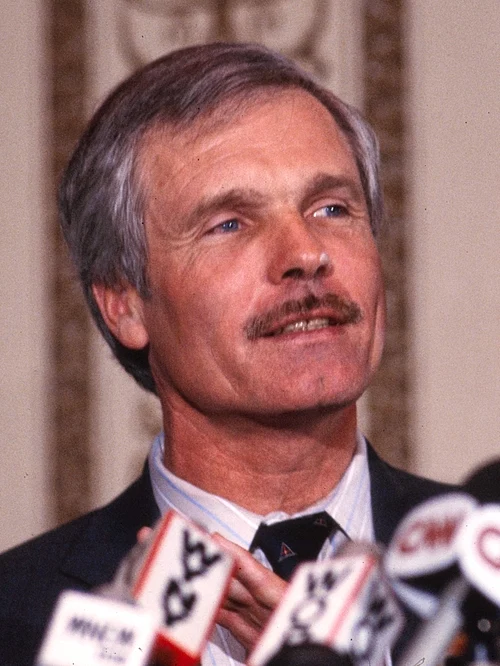
Synopsis
Ted Turner, the media entrepreneur who founded CNN — the world's first 24-hour cable news network — passed away on Wednesday, May 7, 2026, at the age of 87. Surrounded by family, Turner succumbed to Lewy Body Dementia after a prolonged illness. His creation of CNN in 1980 fundamentally altered the architecture of global news delivery, establishing the template of round-the-clock breaking news coverage that has since become industry standard across the world.
The Man Who Reimagined What News Could Be
There are a few instances in the history of broadcast journalism that changed the medium in a way that fundamentally affected not only the way news was broadcasted, but the way people were informed. There are a few times in the history of broadcast journalism that changed the medium in a way that changed not only how news was being broadcasted, but what it meant to be informed in real time. One such occasion was on June 1, 1980, when Atlanta, Georgia businessman Ted Turner founded Cable News Network, CNN. It was a bold concept, even in terms of being generally dismissed: It was the idea of a cable news channel that ran 24 hours a day, when TV news was the nightly news and when the three U.S. television broadcast networks were the dominant makers of news for Americans.
Turner, 87, passed away peacefully surrounded by family on his own doorstep on Wednesday, May 7, 2026, and overcome that scepticism. He proved it so right that the idea of his model was replicated globally as the standard for news organisations. Nowadays, in every major news outlet in the world, the working assumption is that news is available, live, non-stop and around the clock. That's Ted Turner's legacy to journalism.
Lewy Body Dementia: The Long Haul of the fight
Turner's family said that he died after a long illness from Lewy Body Dementia, a progressive degenerative disease of the brain in which abnormal protein deposits (the Lewy bodies) form in nerve cells in areas of the brain responsible for thinking, memory and movement. Lewy Body Dementia is the second most prevalent progressive dementia after Alzheimer's disease, says the National Institute of Neurological Disorders and Stroke (NINDS).
In his later years, Turner publicly discussed his diagnosis, contributing his celebrity to campaigns to raise awareness about the disease and support for patients and carers. His candid disclosure of his condition, a hallmark of his public career of forthrightness, has sparked more visibility for a dementia disease that is not as widely known as Alzheimer's even though it occurs on a much larger scale.
CNN: The Architecture of a Global Institution
CNN's budget when it was founded in 1980 was only a small portion of the budgets of the three major US television networks (ABC, NBC and CBS) that produce news. It did not have an audience, reputation or history. What it had was Turner's sense that there was a demand for the news that didn't stop when the broadcast bulletin stopped, a demand for news that could follow the viewer throughout the day, through the evening, through the night.
CNN's credibility worldwide was put to the test and solidified in 1991 during the Gulf War. To the world, the network's live coverage from Baghdad, as US missiles rained down on the city, was a new kind of real-time war reporting that was unprecedented in the annals of broadcast journalism. CNN's reporting was viewed not just by American television viewers but by presidents, military leaders and diplomats worldwide, even by those in the Iraqi government, as reports indicate. "CNN's coverage of the Gulf War was a watershed moment. For the first time, the world witnessed war unfolding in real time — a development that changed forever how governments, militaries, and the public relate to conflict." — Walter Isaacson, former CNN President, in retrospective commentary
In addition to his work in broadcasting, Turner has left a rich legacy of philanthropy
Turner was not just a media figure; his life was lived in the public sphere. He was a philanthropist who was one of the most influential donors of his day. He made the one billion dollar commitment to United Nations causes in 1997, one of the largest charitable donations in American history, and subsequently created the United Nations Foundation (UNF) to manage the funds. Since then, the foundation has focused on global health, climate change mitigation, sustainable development and nuclear non-proliferation.
Research in Sociology of Media and Its Change in the Media Empire
Turner Broadcasting System is the company Turner developed, which eventually expanded from CNN to include a range of cable TV channels including TNT, TBS and Cartoon Network. One of the major media deals of the 90s was the sale of Turner Broadcasting to Time Warner in 1996, which was valued at around 7.5 billion dollars. Turner was Vice Chairman of Time Warner, and continued to hold considerable power in the media until the following merger with America Online in 2000, considered one of the most unsuccessful business mergers in American history. The transformative energy that had fuelled Turner's media career was taken up by his philanthropic work, activities that increased after Turner's diminished role in the business world. Perhaps his most significant post-media work was his engagement in nuclear disarmament efforts, spearheaded by the Nuclear Threat Initiative (NTI) he co-founded with former US Senator Sam Nunn, and which focused on providing resources and media attention to the existential threat posed by nuclear weapons at a time when they were not receiving adequate mainstream treatment.
A Legacy which outlasted its author
Ted Turner did not just create a television channel, he created a network of television channels. In the decades since the start of CNN, his model of information delivery has been emulated, adapted and even, in some ways, overwhelmed by digital media, but whose underlying logic is the operating premise of global news. It's a belief that major news events will be broadcast live, and that viewers will be able to get a live feed anytime, day or night, and also that journalism is not a scheduled program, but an enterprise. It's assumptions about major events being broadcast live and that viewers can have a continuous stream of information at any hour - day or night - as well as assumptions about journalism not being a given show, but an ongoing process.
At 87, he has left behind the history of a single act of entrepreneurial audacity to a global institution that has witnessed all the major events of the last 40 years. The world which he created — the world where information moves at the speed of transmission — the world where the news never stops — is the world that those who follow him around in journalism live in, and sometimes fail to remember that the world came from him.
Latest News
- ◆NSE's $2.3 Billion IPO Draws Over $10 Billion In Bids
- ◆India-New Zealand Free Trade Pact To Take Effect October 20
- ◆Tata Group Governance Feud Deepens Over Chandrasekaran's Term
- ◆India Reaffirms Push For Constructive Ties With Bangladesh
- ◆Teen Gang-Raped Near Delhi Temple, One Suspect Held In Encounter