
'What If All Cockroaches Came Together?' The Youth Uprising Reshaping India's Politics
Born from a judge's taunt and a cancelled exam, the Cockroach Janta Party has become the most unexpected political force confronting India's establishment in years
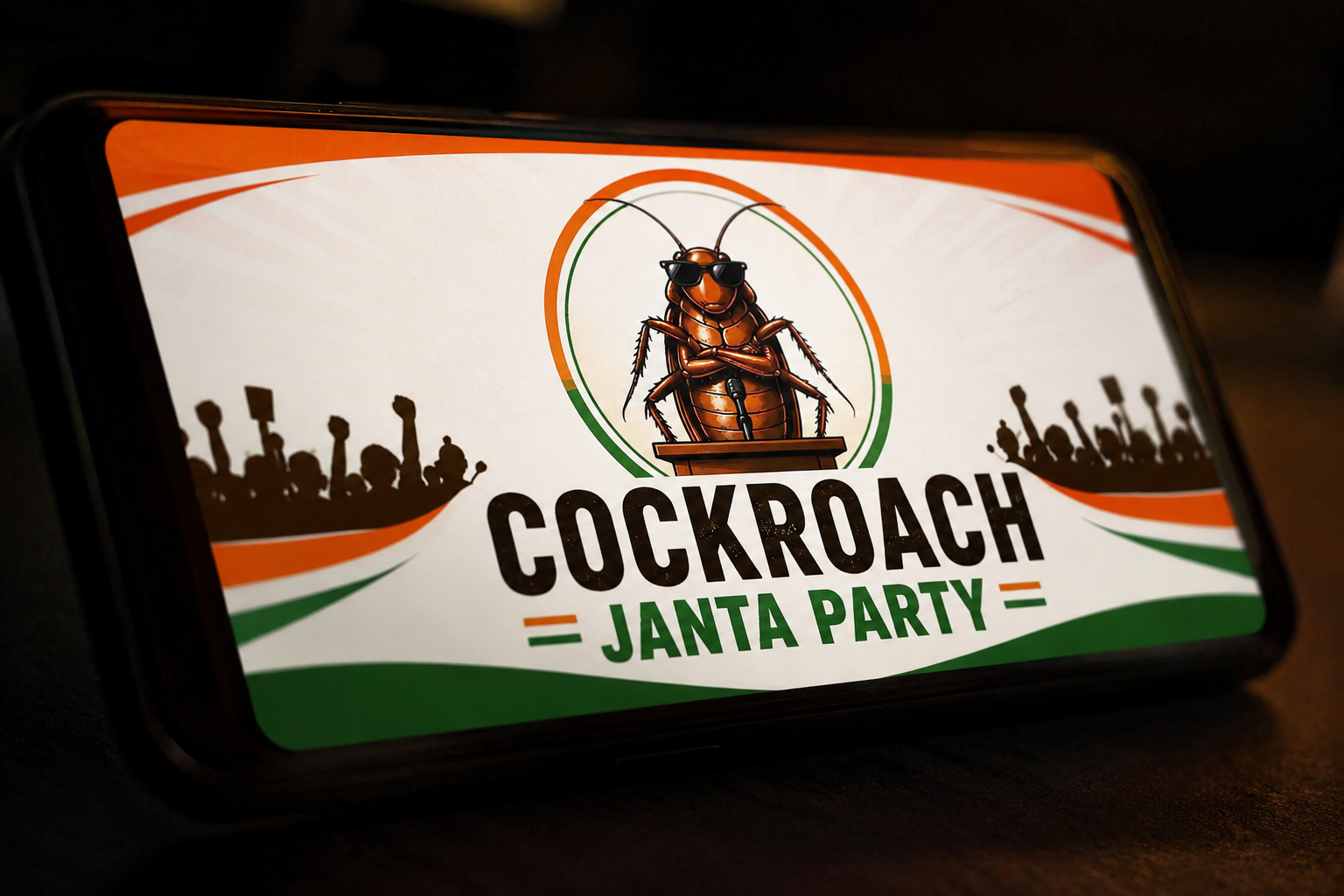
Synopsis
The Cockroach Janta Party, which was established by Abhijeet Dipke on 16 May 2026, after Chief Justice Surya Kant likened the unemployment youth to 'cockroaches', has changed from a social media jest to a street movement across the country in just one month. CJP has staged protest in all 6 cities in front of Union Education Minister Dharmendra Pradhan demanding his resignation on NEET-UG 2026 paper leak and examination failures in the examination system. The fact that it has come out makes one wonder how long the youth will sustain their dissent in a country that has been floundering for more than a decade trying to funnel it into a lasting political transformation.
The one thing they have in common is that they all made a remark that started it all
The Supreme Court of India on May 15, 2026, heard a petitions for contempt filed by a professional against fake professional credentials. Chief Justice Surya Kant, while delivering a statement while hearing the matter, noted that there were youngsters like cockroaches who were not being given any job and do not have any space in the profession, some are becoming media, some social media and some RTI activists.
The Chief Justice then clarified that this was about the ones who have fake degrees and not the youth of India in general. He declared that the young men and women were the "pillars of a developed India. But for millions of young Indians, the damage had been done.
Indian student Abhijeet Dipke (30) in the United States sent a tweet: "What if all cockroaches come together? He then set up a website and social media accounts for the Cockroach Janta Party, an evident play on Prime Minister Narendra Modi's Bharatiya Janata Party. Dipke told Al Jazeera, "Those in power think citizens are cockroaches and parasites.
This was no annoyance that he had tapped into. It was so much more than that
The NEET Crisis: The Kindling That Was There
The CJP's rise to viral fame wasn't a politically free zone. The NEET-UG exam of 3 May was cancelled on 12 May after an investigation into overlaps between a pre-circulated guess paper and the actual exam question paper for more than 2.27 lakh aspirants seeking admission to undergraduate medical and dental courses.
The 20-year-old Ayush Shimpi from Gadchiroli in the tribal belt of Maharashtra had left school for two years to study for the exam. He felt he had come out of the "rat race" when he got out of the examination hall on the 3 May.
The exam was cancelled 9 days later. He is not alone. It symbolizes millions of aspirants who have no other realistic means to escape economic insecurity but by passing competitive exams.
In March 2026, the unemployment rate among young people aged 15-29 in India had reached 15.2 per cent and the youth unemployment rate among females was around 17.7 per cent.
For a generation that's had to deal with government by the BJP for just 12 years, that's on par with an examination system where at least 70 paper leak cases have taken place in the previous seven years alone and involved over 20 million students, according to the Deccan Herald.
There was genuine anger in the post that Dipke picked up. It was waiting – it was already there.
The Movement Goes National: Algorithm to Asphalt
The party's Instagram account reached three million followers in under 78 hours of the CJP's launch. In less than five days it reached the 10 million mark. When Dipke got home from the USA, the CJP had nearly 19 million followers on Instagram, more than double the number of followers of the central government.
From the airport, on 6 June, Dipke moved directly to Jantar Mantar in New Delhi for the first public gathering demanding the resignation of Union Education Minister Dharmendra Pradhan which was organised by the CJP.
He set the minister a 7 day deadline. Upon its expiration, a countrywide wave of protest erupted - in Pune, Lucknow, Amritsar, Bengaluru, Hyderabad and Jaipur, where thousands of people took the streets to protest.
Saurav Das, the spokesman of CJP, said that "people are not going to get jobs out of Hindu-Muslim politics. Exams will not be fixed by that. The government's priorities have to change.
The movement has been an active one in its optics. Protestors have proudly displayed the tricolour banner and there has been no religious rhetoric; both these are deliberate measures to ensure that the political counter-narrative does not take root.
A Manifesto that goes beyond the Exam Hall
The demands of the CJP go beyond just the immediate demand for resignation of Pradhan. The party's official policy document says it will oppose leaking of question papers, faster examination results, transparency in the recruitment process and toughen the accountability of examination authorities.
However, the document goes on. The manifesto calls for the cancellation of all media licenses owned by conglomerates by Mukesh Ambani and Gautam Adani, while reserving 50 per cent of seats in Parliament and all Cabinet posts for women, in the interest of independent media.
It also requires that no retiring Chief Justice should be awarded a seat in the Rajya Sabha as a reward for service post-retirement, a condition with a subtle ring of truth as the Chief Justice's very existence is a reflection of a sitting Chief Justice's observations and has been ruling the land.
The scope of these demands reflects the fact that this originally was a response to a judicial provocation, but in the hands of its architects has been refocused for a broad attack on the political and institutional system.
The State's Response — and What It Reveals
So far, the government's attitude towards the CJP has been fairly moderate, at least publicly. On 13 June, Prime Minister Narendra Modi shared an article on his social media profile in which he said his government was “planning for youth-led development” and that “one of the defining characteristics of the past 12 years has been the confidence among India's young people to pursue their aspirations.”
The CJP wasn't greeted with a smile. Das replied to the statement saying it was "the height of hypocrisy" as on the one hand, the prime minister extols the progress made by the youth, and on the other, he is silent about the number of student suicides and paper leaks has not been mentioned.
The CJP has been careful to avoid violence, the Indian tricolour prominently featured, and the religious aspect kept out of its discourse, all the while the BJP has historically imposed these tags on protests.
It is hard to distinguish the democratic factor from the movement's political dimension. Increasingly, India is being described as an electoral autocracy, as in the V-Dem Institute’s 2026 Democracy Report, which quotes as one of the most frequently cited reports of its kind:
“Under the BJP and Prime Minister Modi, there have been “deteriorations in freedom of expression and independence of the media”, harassments of journalists critical of the government, and attacks on civil society and the opposition.”
The world's largest Gen Z population, as India, has never been governed by any other party other than the BJP headed by Modi.
Moment or Movement? The CJP can't yet answer these questions
There are lessons to be learned from history. The anti-corruption movement of 2011, championed by Anna Hazare, created a lot of street energy, which eventually resulted in the Aam Aadmi Party—and within that the very party where Dipke himself had volunteered!
The BJP has always used a mix of co-option, delegitimisation, divisiveness and direct suppression to defuse youth-led protest energy with possible electoral potential, analysts note.
The CJP's rapid growth also reflects some critics' view of the inability of India's old political parties to address the discontents of the young.
The question of whether the movement will be able to maintain the momentum of its protests beyond the June 20 sit-in at Jantar Mantar and whether it can turn the moral pressure to a tangible institutional response lies at the very heart of this unprecedented month in Indian public life.
Whether this beginning phenomenon will develop into a true social movement, much less a political party, is not known. But there is little doubt that the Chief Justice's comment resonated with a feeling that neither courts, government nor opposition had ever tapped for an extended period.
Latest News
- ◆NSE's $2.3 Billion IPO Draws Over $10 Billion In Bids
- ◆India-New Zealand Free Trade Pact To Take Effect October 20
- ◆Tata Group Governance Feud Deepens Over Chandrasekaran's Term
- ◆India Reaffirms Push For Constructive Ties With Bangladesh
- ◆Teen Gang-Raped Near Delhi Temple, One Suspect Held In Encounter