Abu Dhabi Talks Yield Prisoner Swap; US Envoys Brief Putin, Then Zelensky
Washington says Europeans will join the next round, though the Kremlin has played down that claim; ceasefire and territory remain unresolved
Synopsis
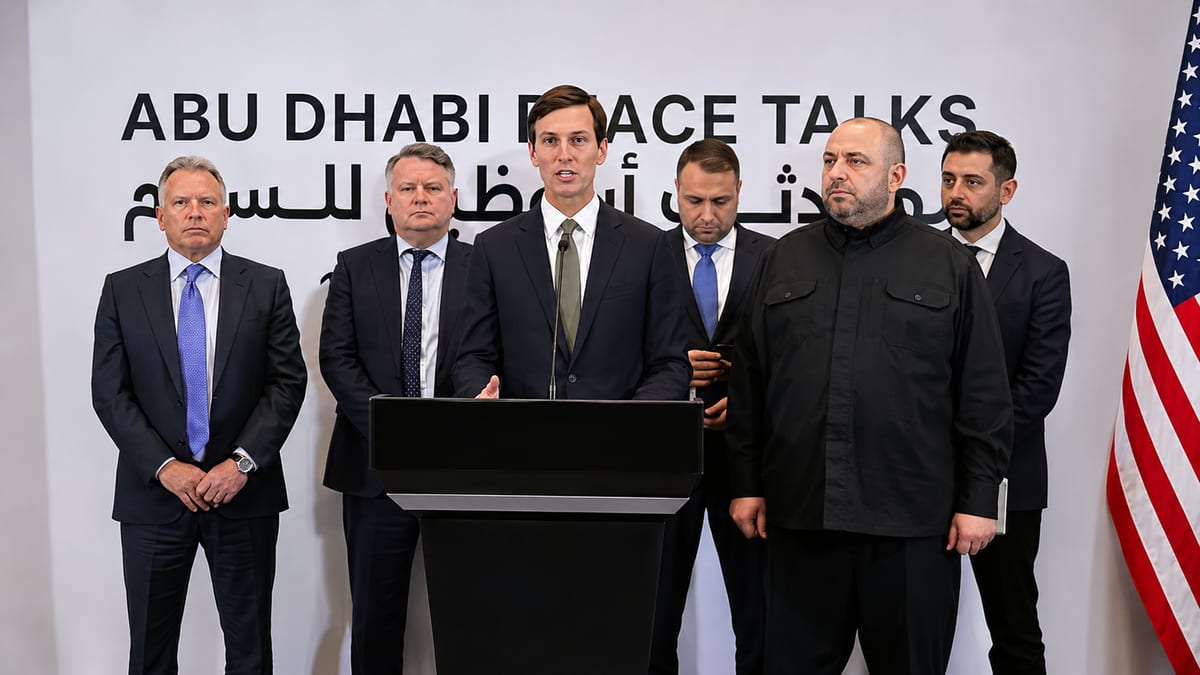
A two-day round of negotiations in Abu Dhabi mediated by the United States on behalf of the leaders of both sides resulted in an "in principle" deal on a large-scale prisoner exchange but on Wednesday no progress was made on any ceasefire or territory deal. In Moscow, Steve Witkoff and Jared Kushner briefed President Vladimir Putin on Thursday, and then Volodymyr Zelensky in Dublin. The Kremlin's report was more muted than Washington's, which said that Europe will be involved in the next round. The Coalition of the Willing is meeting in Berlin next week.
The two-day talks in Abu Dhabi resulted in one tangible outcome. The sides agreed to a “significant” prisoner exchange, the “biggest” of which Kushner declined to provide figures. The talks between the three powers came after a nonstop two-month hiatus, and made little progress.
Agreements reached in Abu Dhabi
The Russian side was led by Vladimir Medinsky and the Ukrainian side was led by Rustem Umerov. The talks mainly concerned humanitarian matters, such as the prisoner exchange, releasing Ukrainian civilians in captivity and Ukrainian children who were brought back to the country, Zelensky said. Security guarantees were also discussed. It was “necessary that the first step be ending this war,” Zelensky said.
The delegation of Ukraine was visited by representatives of European governments, the European Union and NATO. They were not directly involved in the trilateral talks.
The Kremlin meeting
Witkoff and Kushner met Putin in the Kremlin's Senate Palace on Thursday. “Time is,” Witkoff told reporters:
“Let's get it back on track. Let's establish a new meeting.” The information contained in this document was provided by Steve Witkoff, US special envoy.
Later, Kushner said that both sides agreed to involve European partners in the next round of negotiations. The Kremlin was more cautious. Foreign policy aide Yuri Ushakov said trilateral talks would be continued, but downplayed the European involvement. No contacts with EU representatives are planned in Abu Dhabi and none took place, Spokesman Dmitry Peskov said.
Zelensky, who is in Dublin for the European Political Community summit, held a meeting with the envoys later. He indicated that the next round would happen directly with Europe, not separately, and the Coalition of the Willing would meet next week in Berlin. There is no indication that Trump met with Putin, though, as some previous reports suggested, his envoys delivered the message.
Where the sides still differ?
The Council on Foreign Relations rated the talks as having "failed to make any progress," noting that the differences over territory and security guarantees can be difficult to resolve. It said that a possible compromise between European and Russian stances, where the Europeans insisted on no security talks without a ceasefire and the Russians no ceasefire without security talks, was outlined in a possible framework agreement.
In guarantees, NPR reported that officials were considering offering guarantees to Ukraine similar to Article 5, but did not provide any detail. According to Axios, European leaders in Abu Dhabi agreed to move on both tracks in parallel, with emphasis on the fact that any ultimate European security architecture will come after the war.
What to watch
The final prisoner exchange tally, the date and type of the next round of tri-lateral talks, who will represent Europe and the result of the Berlin meeting will all portray how far the diplomacy has progressed. Zelensky and the United States have sought Europe's representative, which European officials did not anticipate naming one of their own.
The humanitarian track has been relocated. The political one hasn't been finalized, it's just scheduled.
Latest News
- ◆FAA Ground Stop Explained: How a maybe Faulty Router Grounded Every Flight in America
- ◆Kylie Jenner Sued for the 4th Time in 7 Months: Do We Smell Legal Trouble?
- ◆Nvidia Controversy Explained: What Jensen Huang’s Exit Means for India’s AI Ambitions
- ◆Huang Resigns as Nvidia CEO; Shares End 4.3% Lower After Early Slump
- ◆Abu Dhabi Talks Yield Prisoner Swap; US Envoys Brief Putin, Then Zelensky
Read More

FBI Seizes or Restrains Over $1.2 Billion Stolen in Binance Heist

Developing World’s External Debt Hits Record $9.4 Trillion as Costs Mount