
BRICS Adopts New Delhi Declaration
India and China stress peace and tranquillity
Synopsis
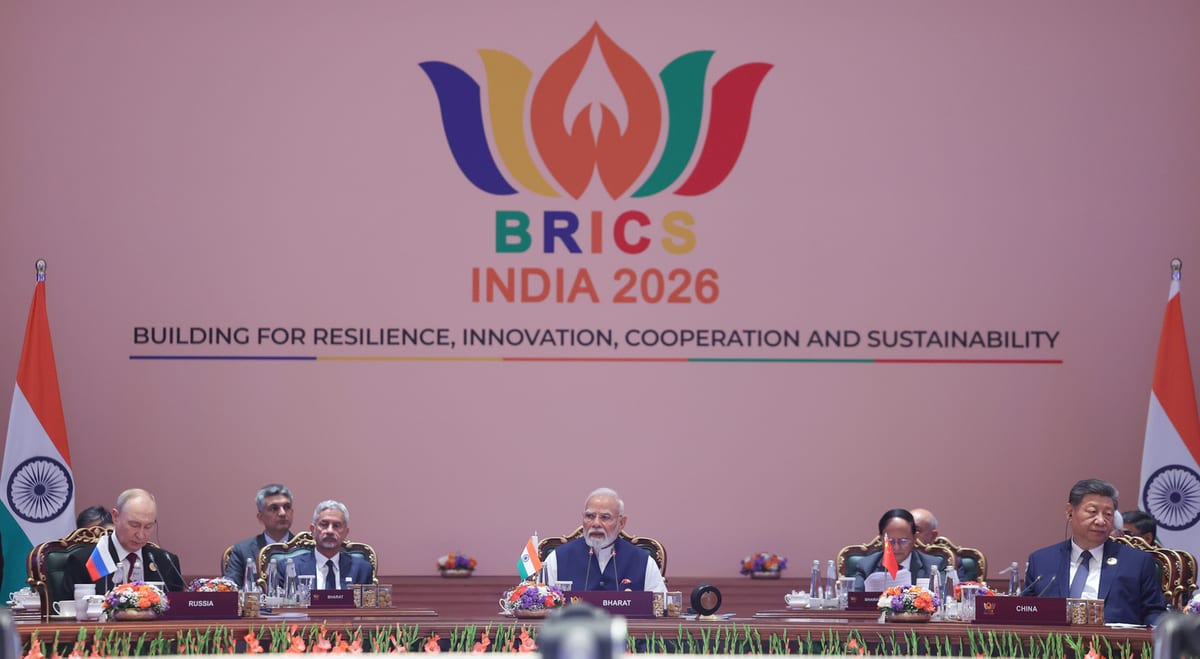
BRICS (Brazil, Russia, India, China, South Africa) nations have unanimously adopted the New Delhi Declaration on the First day of the BRICS Summit 2026, which was being held at Bharat Mandapam in New Delhi. Prime Minister Narendra Modi has proposed to adopt the declaration at the end of the session on the first day of the summit.
The Economic Sanctions
The BRICS countries on Saturday, September 12, 2026, called for an immediate end to unilateral economic sanctions and expressed grave concern over rising protectionist policies, warning that arbitrary tariff hikes and green-labelled trade barriers are disrupting global supply chains and hurting the developing world.
In the New Delhi Declaration adopted during the 18th BRICS Summit, the leaders stated that the global multilateral trading system has reached a critical crossroads. They highlighted that countries are increasingly adopting trade-restrictive measures that violate World Trade Organisation (WTO) rules.
The grouping pointed out that the sudden rise in customs duties, non-tariff barriers, and protectionist restrictions disguised as environmental measures threaten international commerce. The leaders warned that these practices fuel global economic uncertainty, deepen existing disparities between nations, and obstruct worldwide economic growth.
To safeguard global markets, the BRICS nations agreed to collaborate on making the WTO more responsive to trade disruptions while prioritising the economic and development needs of emerging markets and developing countries.
Healthcare Sanctions
called for stronger cooperation in health, including sharing of experiences, innovations and best practices, and endorsed initiatives on tuberculosis, digital healthcare, healthy lifestyles, mental health and traditional medicine.
In the New Delhi Declaration after their meeting, the leaders said they reaffirmed their commitment to advancing universal health coverage through "resilient, inclusive and people-centred approaches".
The declaration said, "We recognise the significance of continued cooperation among the BRICS members and the necessity of sharing valuable experiences, innovations and best practices for improving health outcomes across the BRICS countries."
On Representation
The Indian Prime Minister Narendra Modi announced the consensus document at the summit at the Bharat Mandapam in New Delhi, stating that the changing global order should not be run by outdated institutions as he pushed for reforms and necessary representation in rule-making.
The Declaration also called for stronger multilateralism and greater participation of emerging and developing economies in global decision-making.
The declaration specifically called for reform of the UN Security Council, with greater representation for developing countries from Africa, Asia and Latin America and the Caribbean. The grouping said developing countries must have a greater voice in international institutions. China and Russia, the two permanent members of the Security Council represented at the summit, reiterated their support for the aspirations of Brazil and India to play a greater role at the United Nations, including on the Security Council.
On Global Conflicts
On global conflicts, BRICS expressed deep concern over the escalation in West Asia, calling for maximum restraint, protection of civilians and civilian infrastructure, and dialogue and diplomacy towards lasting peace. The declaration also called for maintaining the flow of global trade, supply chains and energy. It also denounced “unilateral acts of war” and stressed the need to ensure the safety of seafarers and commercial navigation amid the ongoing military aggression in West Asia.
On Gaza, it urged adherence to the ceasefire, unhindered humanitarian access and an end to forced displacement, while reaffirming support for a two-state solution and Palestine’s full UN membership.
The declaration also strongly condemned terrorism in all its forms and specifically condemned the April 22, 2025 terrorist attack in Pahalgam, which killed 26 people. BRICS called for stronger action against cross-border terrorism, terror financing and safe havens, and urged that those involved in terrorist activities and their support networks be held accountable. It also called for deeper cooperation against extremism, radicalisation, organised crime, money laundering and cross-border fraud networks.