
India’s “Eye in the sky”
ISRO Launches first-ever imaging satellite, providing continuous Earth observation data
Synopsis
On Friday, September 4, 2026, at 2.55 a.m. ISRO launched its EOS-05 is a state-of-the-art Earth observation spacecraft, also known as Gisat-1A, ending the space agency’s eight-month-long lull to get the imaging satellite. ISRO chief Narayanan noted that the space agency is targeting six more launches during the current financial year.
ISRO Launches EOS-05, India's First Geo-Imaging Satellite
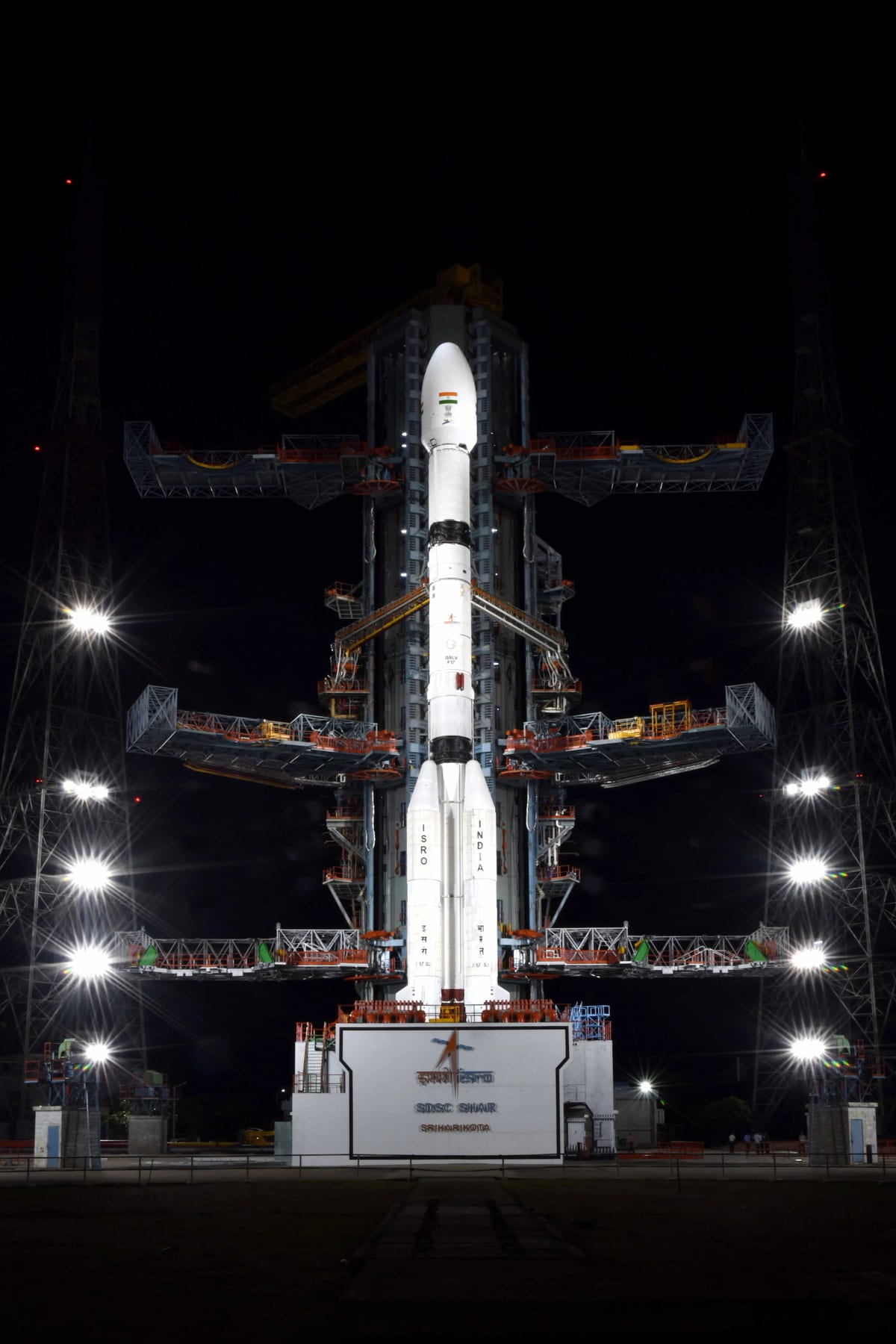
The Indian Space Research Organisation (ISRO) successfully launched its EOS-05 satellite, India’s first-ever imaging satellite, providing continuous Earth observation data. Geosynchronous Satellite Launch Vehicle (GSLV) soared into the sky, carrying ‘Smart Boy’, the country’s first imaging satellite. Eighteen minutes after lift-off from the second launch pad of the Satish Dhawan Space Centre in Sriharikota, Andhra Pradesh, India.
ISRO Chairman V Narayanan, “I am very happy to announce that the GSLV-F17 vehicle has successfully and precisely injected the advanced Earth observation satellite EOS-05, the Geo Imaging Satellite, into the intended and required orbit,” adding that the satellite was in “perfect health” after the injection, calling the mission a “great achievement” for India’s space programme.
Why EOS-05 satellite so important?
EOS-05 is a state-of-the-art Earth observation spacecraft, also known as Gisat-1A, low Earth orbit satellites pass over a location periodically. What sets EOS-05 apart from the rest is that it will continuously monitor Indian Territory and the surrounding regions from nearly 36,000 km above Earth.
It will go long way towards providing critical information about weather systems, disasters, infrastructure monitoring, and general surveillance of the territory. Essentially, the satellite becomes India’s ‘Eye in the Sky’, providing real-time imagery besides helping agriculture, environment, disaster management among others.
Science and Technology Minister Jitendra Singh noted that India’s space capabilities continue to scale new heights, strengthening the country’s position as a global space power.
Jitendra Singh wrote on X, “EOS-05 is a state-of-the-art Earth Observation satellite and India’s first imaging satellite from geosynchronous orbit, enabling advanced imaging across visible, infrared, multispectral and hyperspectral bands.”
What is Gisat -1A?
ISRO is designing a GEO Imaging Satellite (GISAT). It will carry a GEO Imager with multi-spectral (visible, near infrared, and thermal), multi-resolution (50m to 1.5 km) imaging instruments. GISAT will be placed in a geostationary orbit of 36,000 km.
The remote sensing satellites launched by ISRO revisit the same area once in every 2 to 24 days and acquire images of a geographical strip at different spatial resolution. GISAT will provide near real-time pictures of large areas of the country, under cloud-free conditions, at frequent intervals.
Long-delayed replacement for Gisat-1, which was lost in August 2021 midway through its launch. On August 12, 2021, ISRO launched EOS-03, also known as Gisat-1. However, the rocket, a GSLV Mark II, experienced an anomaly with its third stage, and the satellite was lost.
“The first launch of the GSLV was with a payload of 1,536 kg. Since then we have gradually improved the performance of this vehicle by optimising the structural mass and improving the propulsion system and today we have injected the heaviest satellite, 2,367 kg, launched with this vehicle,”
What comes next for ISRO
The successful launch of the EOS-05 comes as a huge relief for Isro, which has not carried out any launch activities since the failure of the PSLV-C62 mission carrying the EOS-N1 earth observation satellite on January 12, 2026.
ISRO chief Narayanan noted that the space agency is targeting six more launches during the current financial year. This includes the uncrewed Gaganyaan mission later this calendar year.
Latest News
- ◆Victoria’s Secret 2026: Redefining Beauty on the Runway
- ◆From Jane Austen to Jenny Han: How Literature Reflects Changing Human Relationships
- ◆New Fits, Old Roots: Rethinking Diwali Fashion in 2026
- ◆The Reality Behind the Rocketry: Breaking Down Tesla’s 2028 Roadster Reveal
- ◆Supreme Court Recognises Children’s Right to Internet Access, Cautions Against Blanket Bans