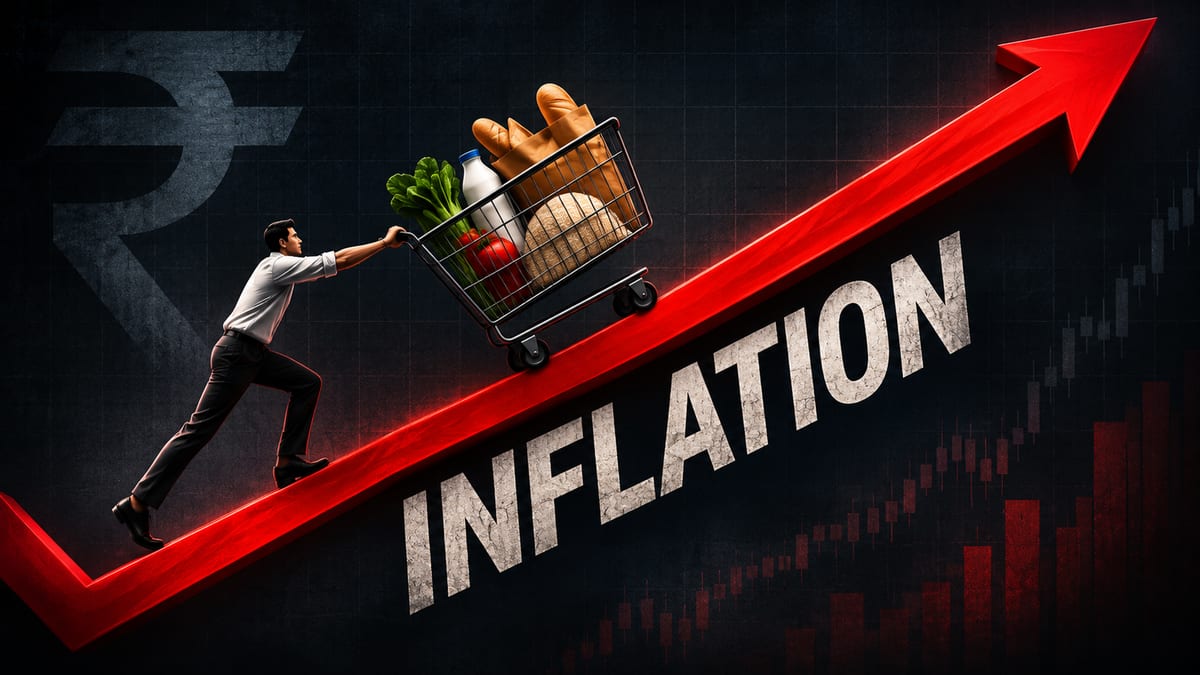
India’s Retail Inflation Breaches RBI’s 6% Limit as Food Prices Surge
October CPI inflation rose to 6.09%, a two-year high, while food inflation reached 8.94%; economists expect the RBI to weigh another rate increase in December
Synopsis
India's retail inflation jumped to a two-year high of 6.09% in October, exceeding the 6% upper tolerance band of the Reserve Bank of India (RBI), on back of food inflation which surged to 8.94% on back of dearer onions, garlic and ginger. The inflation rate in rural areas (6.63%) was higher than the urban inflation rate (5.41%). The RBI put its repo rate up to 5.50 per cent in October for the first time in almost four years and economists now expect another hike in the rate during the review in December.
The Ministry of Statistics and Programme Implementation (MSPI) reported a provisional 6.09% inflation in India's consumer price index (CPI) on the new base year of 2024 for October 2026 as compared with the same period of 2025.
It was the first time in two years that it exceeded the upper tolerance limit of the RBI. It is also the highest reading since the new series was introduced. The RBI's target is 4%, and a tolerance level of ±2 percentage points.
Food drives the surge
Consumer food prices increased in October as measured by the Consumer Food Price Index (CFPI) to 8.94% from 7.74% in September. Prices of onions, garlic and ginger climbed. The Reuters poll of economists had predicted 5.93% for October, up from 5.54% in September.
The headline rate also exceeded the individual rates in rural areas (6.63%) and urban areas (5.41%). That gap is significant because the share of food in rural households' budgets is greater.
The RBI’s position
The RBI hiked its benchmark policy rate by 0.25 percentage points to 5.50% in October for the first time in almost four years warning that more rate increases might be necessary in the coming months given the high rate of inflation, weak rupee and high crude oil prices. Thereafter, the central bank had revised the estimate of CPI inflation for FY27 to 5.2%.
October print is much higher than the path of that projection. The economists are expecting the policy rate to go up next month. Media reports also suggests a rate hike in December is expected. With adequate foodgrain stocks and government intervention, the impact could be dampened to a certain degree, said one economist quoted in a DNA explainer. That is based on the assumption of food grain stocks and government intervention reducing prices. Retail inflation is going above the upper limit of the RBI's tolerance band of 6.09 pc; rate hike likely next month.
What to watch
The next review will be in December Monetary Policy Committee. Policymakers have to balance inflation and growth – and the rise in food prices is in part supply-side, and so that has only indirect impact from monetary policy. The other factor the RBI has mentioned is the price of Brent crude, which is trading at around $92 to $95 a barrel this week.
Latest News
- ◆FAA Ground Stop Explained: How a maybe Faulty Router Grounded Every Flight in America
- ◆Kylie Jenner Sued for the 4th Time in 7 Months: Do We Smell Legal Trouble?
- ◆Nvidia Controversy Explained: What Jensen Huang’s Exit Means for India’s AI Ambitions
- ◆Huang Resigns as Nvidia CEO; Shares End 4.3% Lower After Early Slump
- ◆Abu Dhabi Talks Yield Prisoner Swap; US Envoys Brief Putin, Then Zelensky
Read More

Nvidia Controversy Explained: What Jensen Huang’s Exit Means for India’s AI Ambitions

Huang Resigns as Nvidia CEO; Shares End 4.3% Lower After Early Slump