
Nepal Flood Death Toll Crosses 1,000 Mark
The confirmed toll from catastrophic Himalayan flash floods surpassed 1,000, with nearly 4,000 people still missing as rescue efforts continue
Synopsis
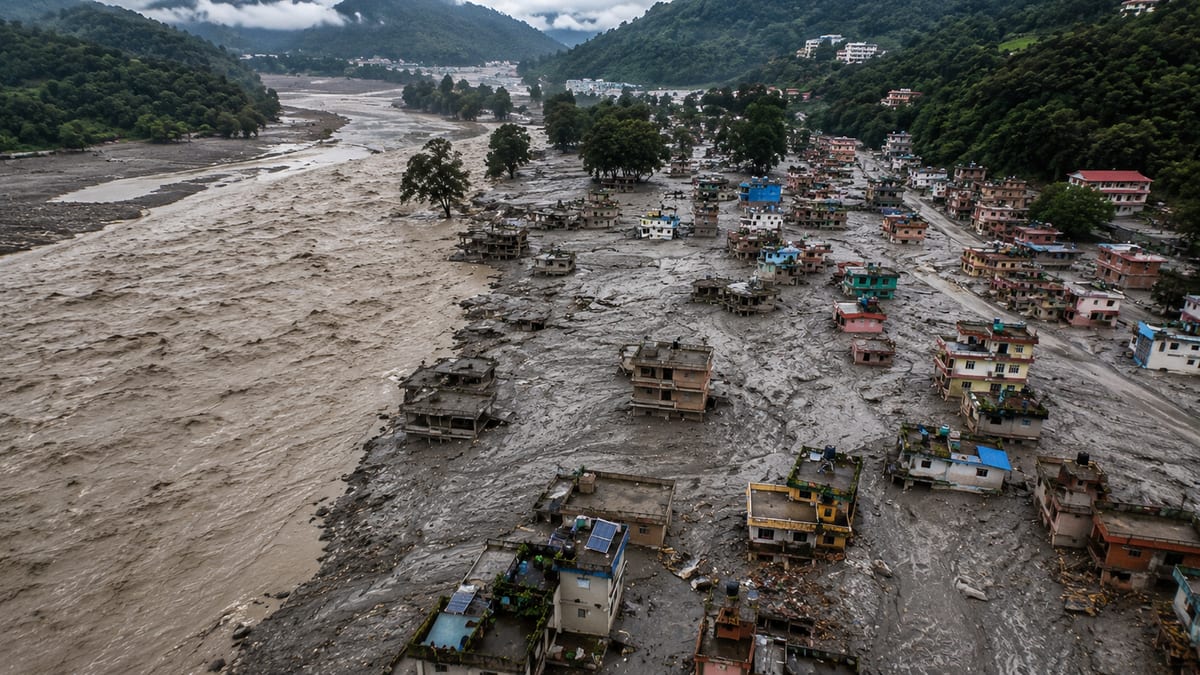
By September 1, the death toll of the catastrophic flash floods in Nepal and Tibet on August 26 had passed 1,000 and 3,916 people are still unaccounted for in Nepal alone. The incident, which resulted from a collapse of a glacier in the Himalayas, caused damage to the Gyirong border crossing and affected the communities living along 72 kilometres of the Trishuli River.
A Catastrophe with an Accelerating Rate
More than 1,019 people died in Nepal and China due to the catastrophic flooding and over 4,400 are still missing, as rescue teams struggle to access communities isolated by the disaster.
Nepal's National Disaster Risk Reduction and Management Authority raised the death toll to 1,003, 3,916 people unaccounted in the country, including 583 foreigners, in an update on Tuesday, while the Chinese authorities reported 16 deaths and 546 missing, including 261 foreigners.
The disaster started
The tragedy started from the high Himalayas. A flash flood swept across a 72 km section of the Trishuli River in Nepal on 26 August 2026, and demolished the Gyirong checkpoint on the China-Nepal border, before the event ended. Researchers have pinpointed the cause as geologic restabilization.
It is believed that it was triggered by a collapse of a glacier that triggered a chain reaction on Langtang Lirung in the Himalayas and produced a tremor of magnitude Ms 5.2, which was felt all over the world by seismometers. Some victims were swept away 240 km to neighbouring India.
Rescue Operations are conducted in a difficult terrain
Nepalese government officials have recovered at least 11,814 people so far, with the help of helicopters and other aircraft in regions where roads and bridges have been destroyed. Rescue efforts have been hampered by many challenges.
Rescuers have faced difficulties due to mountainous terrain, bad weather, wrecked infrastructure, and power outages, among other challenges.
David Fisher, Head of the International Federation of the Red Cross for Nepal, said that their main concern is the risk of a resurgence of flooding despite the efforts being made by authorities to reopen roads that have been barred to communities still not getting much assistance.
The Human Cost of Mass Burials by Naoko Kato, Maria Kolomna, and Hiroaki Togashi
As bodies started to decompose in a rapid fashion, the authorities have started to practice mass burials. The dead were buried in mass graves, including one in Chitwan, Police Inspector Anil Thapa said, where 199 dead bodies were buried in one temporary burial ground, while about 80 were to be buried in another.
The bodies have already decomposed," Thapa said, "when we found them, they were already in a state of decomposition; so it was very difficult to put them inside the city area. That is the reason why we must do this.
UN Assessment and Humanitarian Response
As of late Tuesday, the death toll had risen to slightly over 1,000, with some 4,247 people still unaccounted for, said Jens Laerke, an OCHA spokesperson in Geneva. Now there is a greater focus on longer-term recovery by humanitarian agencies.
Over 10,000 households along the Trishuli corridor are in need of emergency shelter and relief materials; the flood has also closed the overland pass between Kathmandu and Tibet.
Cross-Border Trade Disruption
The direct impact of the flooding was on the Tibetan side, through the Gyirong Port, where almost one-third of the trade between Nepal and China passed through in 2024.
It takes a long road to recovery
Thousands remain missing and damage to infrastructure runs across entire river valleys; authorities warn both the death toll and the scope of reconstruction will continue to increase in the coming weeks.