
EC Insists All SIR Orders Won Unanimous Panel Approval
Election Commission rebuts reports of internal dissent over Special Intensive Revision, says statutory checks are routine
Synopsis
The Election Commission of India has reiterated that every Electoral roll revision work related to the Special Intensive Revision of electoral rolls, including changes done on Form 6, was approved unanimously by all three Commissioners. The clarification comes after complaints were recorded by two Commissioners over the Commission's not taking up their own time to ensure greater transparency on its internal working, which has led to political demands for the same.
Commission seeks to quell controversy by moving forward
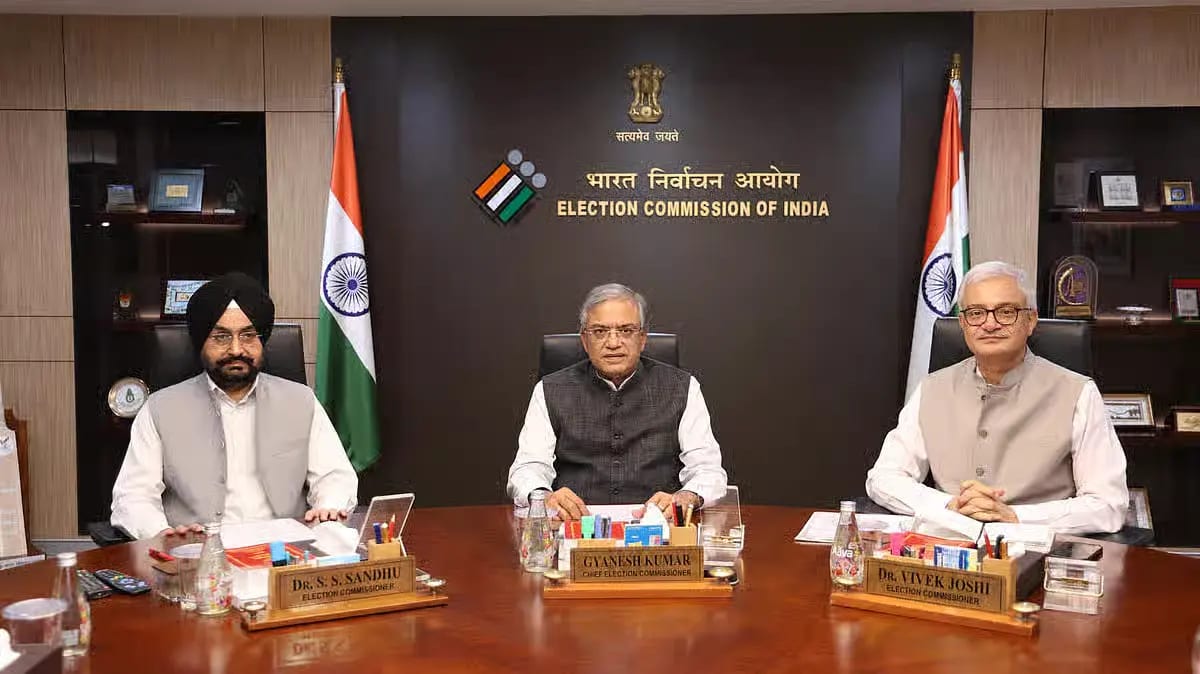
In a categorical statement, the Election Commission of India (ECI) said that all orders related to the Special Intensive Revision (SIR) of the electoral rolls were passed unanimously by Chief Election Commissioner Gyanesh Kumar and Election Commissioners Sukhbir Singh Sandhu and Vivek Joshi.
The clarification was issued following a full Commission Meeting held on 26th Sept 2026 at Nirvachan Sadan, New Delhi, which was held with a specific view to addressing the reports of internal friction.
The Commission reiterated that all SIR orders had been passed unanimously and also announced a series of “voter-friendly changes.” A new committee led by the Senior Deputy Election Commissioner and comprising of an independent technologist from the IIT/IIIT system will now be verifying compliance of the ECINET portal with statutes, officials familiar with the deliberations said.
What had caused the dispute?
The row broke out after a report by the investigative committee objected that the commissioners Sandhu and Joshi had placed formal objections on record regarding various matters.
The report stated that the two Commissioners had expressed their concern on a number of matters pertaining to voter registration and deletion, changes to Form 6, electoral-roll databases and aspects of the SIR process, some a matter of decisions taken without their knowledge or approval.
In response, the Commission continued to have a unified stance. The ECI has always insisted that written notes, observations and internal checks form a part of the normal deliberative process and the ultimate decisions which were taken by the Commission were unanimous.
The Commission also discussed a specific procedural issue relating to officer-level orders. It stated that the two Commissioners' orders were not implemented and the officer in question had not issued any work re-distribution orders, and that the oversight of the IT division of the Deputy Election Commissioner had not been withdrawn.
The Commission that cites the Legal Timeline
The ECI has called for judicial validation to shore up its case several times. It pointed out that the SIR Order dated 24th June 2025 obtained approval from all the members of the Commission and was approved by the Supreme Court in its Order dated May 27, 2026 and the schedules to the SIR across 12 States/Union Territories were issued on 27th October 2025 with unanimous approval of the Commission and the schedules for 19 more States/Union Territories were issued on 14th May 2026 with the approval of all members of the Commission.
The Commission has also indicated that it will not be able to confirm the final elector count until the remaining Phase 3 states have published.
Election Commission Chief Election Commissioner O.P. Rawat reported that "dissent in the Election Commission is not a problem in itself and that the decisions are made either by a majority or unanimously.
Political Reverberations
The ECI's clarification has sparked a broader political struggle, during which the Opposition leaders want the Commission to be more closely watched. The real question is no longer just whether Commissioners had divergent opinions as they deliberated on the matter internally, but how those opinions were taken into account and how the Commission finally arrives at its final decisions, analysts note.
Institutional Stakes
The SIR exercise was called into question just because of its importance as an electoral legitimacy measure and voter-list accuracy, which is being incorporated in India's upcoming elections.
The reports on objections to electoral-roll management have been on the records, further fuelling a demand for transparency in its management, as the Commission has claimed to have acted with procedural unanimity. The ability of the Commission to reconcile internal differences with popular unity will probably play a significant role in the trust shown in the roll-revision process as India heads into the next elections.