
NASA Invites ISRO to join Moon Base Programme
NASA's Three-Phase begins with robotic missions to build Infrastructure for Astronauts
Synopsis
For generations, people have promised their partners, ‘I’ll bring you the moon and the stars.’ But the story is taking a twist. NASA is now building a Moon Base, a long-term plan to study, explore and eventually live and work on the lunar surface. What was once a romantic metaphor is slowly becoming an engineering Project.
NASA ISRO Moon Base Collaboration
“We're going back to the Moon to stay, and we're bringing our partners with us.” The National Aeronautics and Space Administration (NASA) has invited the Indian Space Research Organisation (ISRO) to collaborate on the Moon Base Programme. Expanding on the U.S. – India partnership under the Artemis Accords. The Ninth meeting of the India-U.S. Civil Space Joint Working Group was hosted in Bengaluru, India, on August 5th - 6th, 2026. Highlighting bilateral space cooperation, ISRO Chairman Dr. V. Narayanan and US Ambassador to India, Sergio Gor, addressed the opening segment.
What is the Moon Base Programme?
The National Aeronautics and Space Administration (NASA) is on its way to an endeavour in Human History. The Moon Base will be built step by step through a series of robotic and human missions that help us learn how to live and operate in one of the most demanding and dangerous environments humans have ever set out to explore.
Earlier, people from all over the world used to fantasise about living on the Moon. NASA launched the Moon Base Programme on March 24, 2026, under the leadership of Program Manager Carlos García-Galán. He oversees the development of the Moon Base and guides NASA in expanding exploration of the Moon, drawing on more than 3 decades of experience in human spaceflight.
NASA Unites Partners for Moon Base
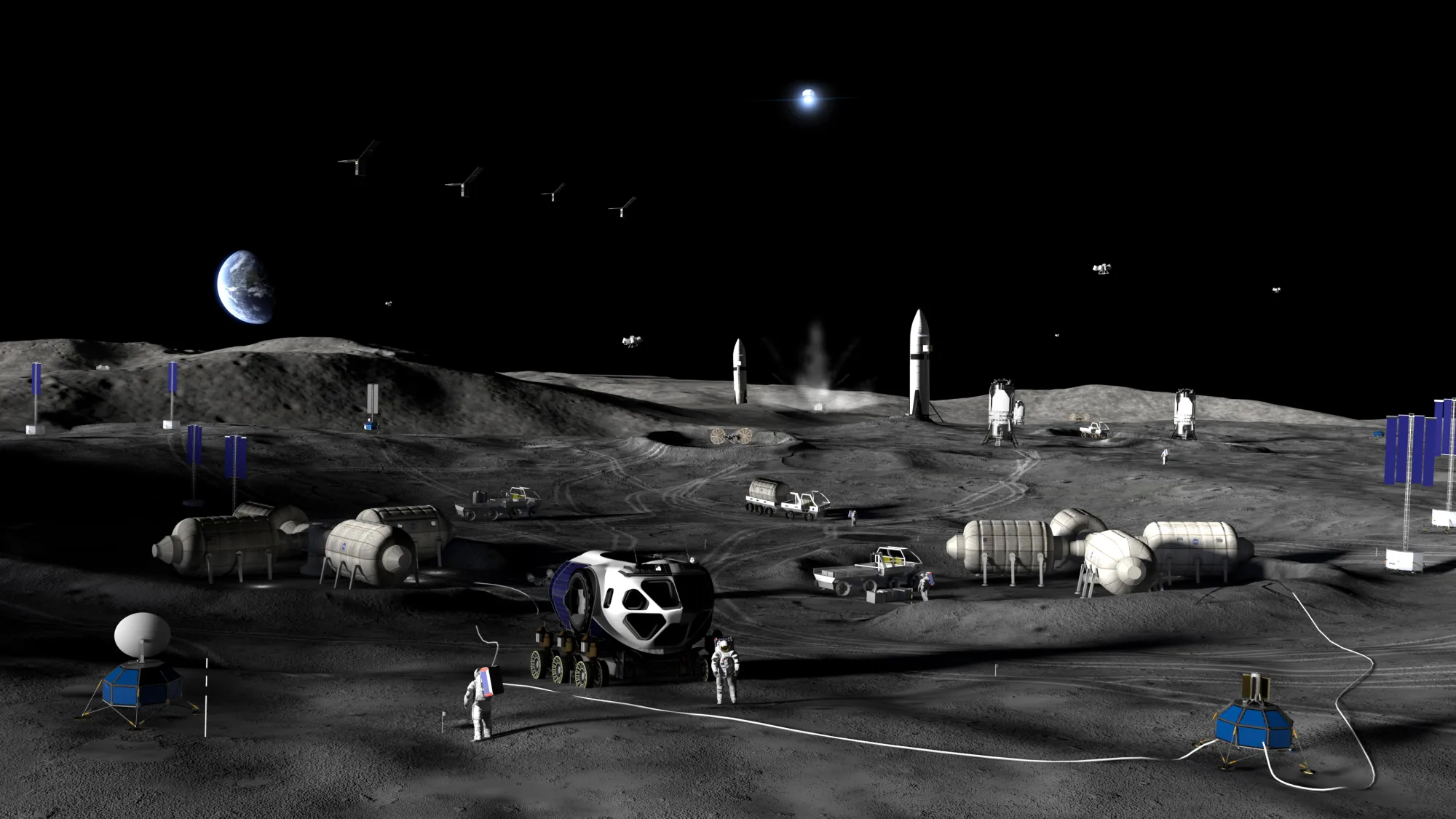
NASA’s Moon Base strategy combines the strengths of government, private innovation, and global collaboration. The agency selected Astrolab and Lunar Outpost to develop lunar terrain vehicles (LTVs). NASA gave Blue Origin contracts to help transport the lunar vehicles from Earth to the Moon’s surface. NASA selected Firefly Aerospace to build the spacecraft that will carry NASA’s Moon Fall drones to the Moon.
Explore, Build and Live on the Moon
The Moon Base is built on a step-by-step phased approach. NASA has introduced a Three-Phased approach: begin with robotic missions that explore the lunar environment and test new technologies, and further establish the systems and infrastructure needed for astronauts to live and work on the Moon.
Phase One: Explore and Assess | 2026 – 29
The First phase prioritises gaining a deeper understanding of the environment and lunar surface. Robotic missions will explore the lunar South Pole in terms of resources, surface, rocks, soil, water ice and environment. Help NASA identify high-potential sites for upcoming development projects.
Phase Two: Develop and Establish | 2029-2032
Following the learnings during Phase One, NASA will begin establishing the infrastructure needed to support sustained lunar operations. Early power systems, cargo transportation, logistics, and communications capabilities will increase the possibility of complex missions. By establishing infrastructure across multiple locations, NASA will create a flexible foundation that can support ongoing exploration and future expansion projects of the Moon Base.
Phase Three: Sustain Human Presence | 2032 and beyond
With the established foundational infrastructure, NASA will begin assembling a permanent lunar outpost where Astronauts can live and research for extended periods. Habitats, power systems, communications, transportation, and other critical capabilities will come together to support a human presence near the Moon’s South Pole.
NASA is not building a lunar city, it is prioritizing the supply chain, vehicles, robotics, communications and survival technologies that could make one possible.