
Rare Total Solar Eclipse Crosses Europe
The year's only total solar eclipse traces a path across Greenland, Iceland and Spain, marking the first time totality has touched mainland Europe since 1999
Synopsis
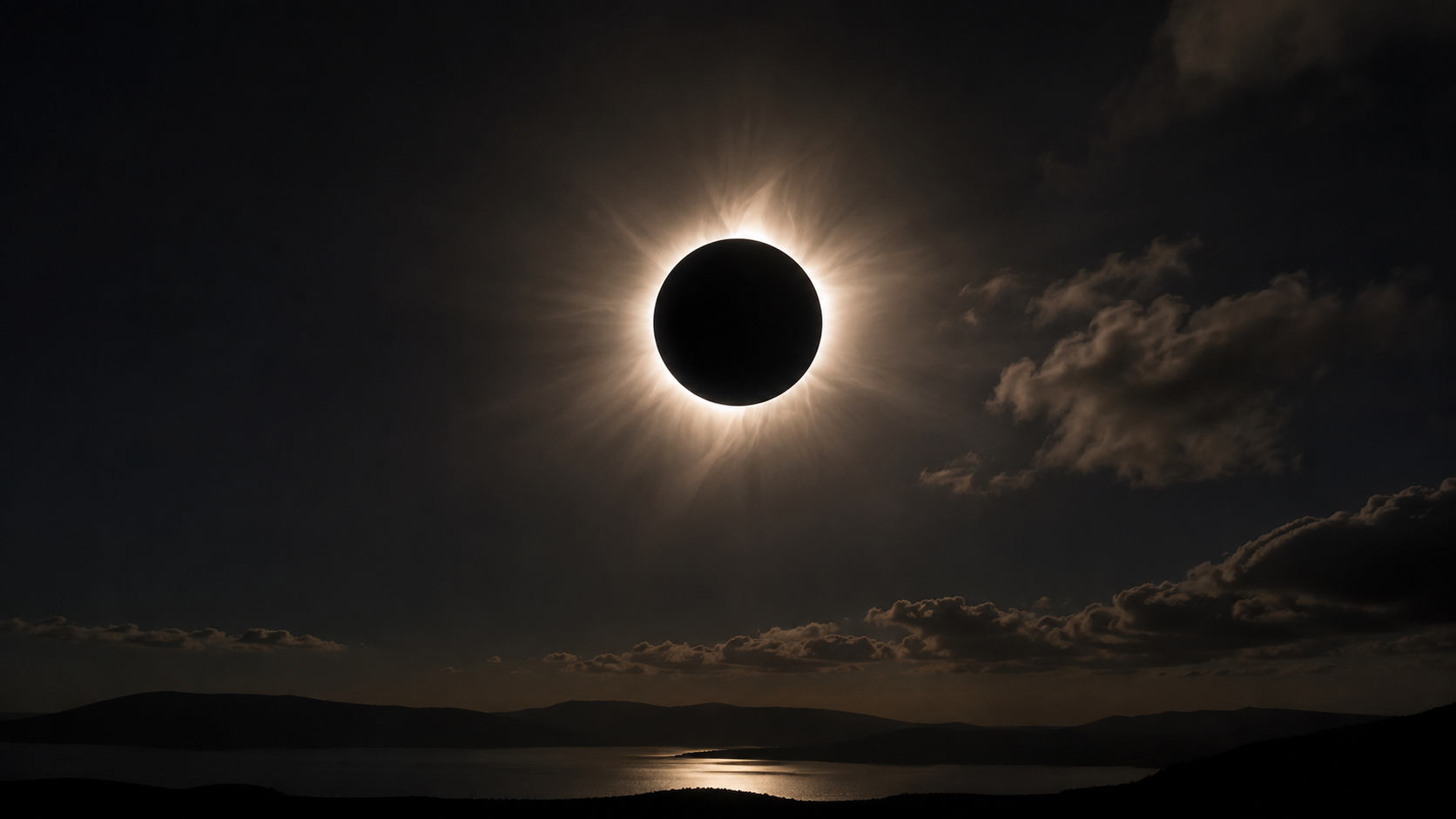
Today is the only 2026 total solar eclipse, limited to a thin corridor through far Siberia, Greenland, Iceland and the northern coast of Spain — the first to darken mainland Europe since 1999, providing coveted views of the corona of the sun.
The Path of Totality
A total solar eclipse will traverse Greenland, Iceland, northern Russia, the Atlantic Ocean, Spain and a small part of Portugal on 12 August 2026, while many other areas in the Northern Hemisphere will experience a partial eclipse.
This eclipse will have a maximum totality of two minutes and 18 seconds along a far-travelled path in eastern Greenland, across the west coast of Iceland, the north coast of Spain, and over only a small part of Portugal.
The route was an unusual one in the Arctic Circle
The eclipse has an unusual track. Most total solar eclipses move from west to east, but the path of totality for August 12, 2026, snakes up and over the North Pole. As with all eclipses, the eclipse starts at sunrise, here over the uninhabited Taymyr Peninsula in Siberian Russia, at the unusual time of 11:59 pm on the centerline, which is Arctic summertime.
When and Where to See It
The shadow of the Moon will first pass over the Arctic circle of the northern territories of Russia and thereafter travel over the east coast of Greenland. The western coast of Iceland, including the Snæfellsnes peninsula, will start to see totality at approximately 5:45 pm local time (17:45 UT).
Those observing the eclipse in North America should tune in starting at 2 pm ET, with totality sweeping into northeastern Greenland around 1 pm ET and western Iceland around 1:45 pm ET, with totality in Reykjavik at 5:48 pm.
Totality arrives in northern Spain around 2:30 pm ET (8:32 pm local time in Valencia), after crossing the North Atlantic where the partial eclipse will be best seen from the UK with 91% coverage in London.
The entire trip will be complete by 2:45 pm ET. Outside the direct path of totality, at least 90% of the path will be covered by most of the bigger cities in Europe, such as Madrid, London and Paris.
A Historic Return for Europe
This is also the last complete solar eclipse to be seen from the mainland of Europe since 1999. Since then, 18 total solar eclipses have occurred around the world, but the path of totality has twice crossed the edge of the European continent: twice in 2006, over Georgia and Russia; and twice in 2015, over the Faroe Islands and Svalbard. This is the first total solar eclipse to see from Spain since 1905.
A Notably Wide Path
The path of totality for the typical eclipse is about 150 kilometres (about 90 miles) wide, but as it moves across Spain for this eclipse, it is unusually wide, passing across the entire Iberian peninsula from the north coast to the Mediterranean Sea, about 290 kilometres (about 180 miles) wide.
Safety First
Eclipse safety advice is simple and can't be changed: Only during the brief period of totality on eclipse day can eclipse observers view the sun without protective eyewear, but at any other time during the partial phases of eclipse, they must use certified eclipse glasses or eclipse viewers to prevent serious eye damage.
What's the point of this other than showiness?
Total solar eclipses provide scientists with a brief and unique opportunity to observe the sun's corona, the outermost part of the sun's atmosphere, that is usually hidden from view by the sun's glare, by instruments that would otherwise have to be put into orbit around the sun.
For the general population such events are also often accompanied by dramatic “eclipse tourism”, and the hotels and viewing sites of the eclipse path in Iceland and Spain are already booked for months.
Looking Ahead
The eclipse itself will return to other parts of the world about every 18 months, but any given location will usually have to wait much longer — and that's why today's rare alignment over Iceland and Spain has garnered so much worldwide attention.